
Why do we gain belly fat as we age? If you’ve been eating much the same as you always have and haven’t dramatically changed your activity levels, it can be frustrating to see your waistline gradually expand in your late thirties, forties, or beyond. Many people assume it’s simply a result of slowing metabolism or poor lifestyle choices, but emerging research suggests the story is more complex. Scientists are discovering that age-related changes within our bodies may actively encourage fat to accumulate around the abdomen, helping explain why losing belly fat often becomes more challenging with each passing decade.
You’re eating roughly the same as you always have. You’re not noticeably less active. But somewhere in your late thirties or forties, the belly starts to change anyway — and no amount of calorie-counting seems to explain it completely.
That experience is frustrating precisely because it feels unfair. And it turns out, there’s a biological reason it happens that has nothing to do with discipline or lifestyle choices.
A study published in the journal Science in June 2026 by researchers at City of Hope and UCLA has, for the first time, identified the specific cellular mechanism responsible for age-related belly fat accumulation. And it’s considerably more interesting — and more hopeful in terms of future treatments — than “you’re just getting older.”
The Fat You Can’t See Is the Fat That Matters Most
Before getting into the new finding, it’s worth understanding exactly which fat we’re talking about — because not all body fat is the same.
The fat that sits just under the skin, the kind you can pinch, is called subcutaneous fat. It’s largely cosmetic in terms of health risk.
The fat that builds up around the abdominal area and wraps around internal organs — the liver, kidneys, intestines, pancreas — is called visceral fat. This is the type that genuinely concerns doctors, and it’s this specific fat that tends to increase with age even in people whose overall body weight stays roughly stable.
Scientists have long known that body composition changes with age, but exactly why fat tends to accumulate around the midsection has remained unclear — until now. ScienceDaily
Visceral fat is metabolically active in a way that subcutaneous fat isn’t. It releases inflammatory compounds, disrupts insulin signaling, and has been consistently linked to cardiovascular disease, type 2 diabetes, and metabolic syndrome. More recently, it has also been associated with accelerated brain aging and elevated Alzheimer’s risk.
The Stem Cell Discovery That Changes Everything
The new research centers on a type of cell called adipocyte progenitor cells, or APCs — essentially stem cells that live in fatty tissue and have the potential to develop into fully formed fat cells.
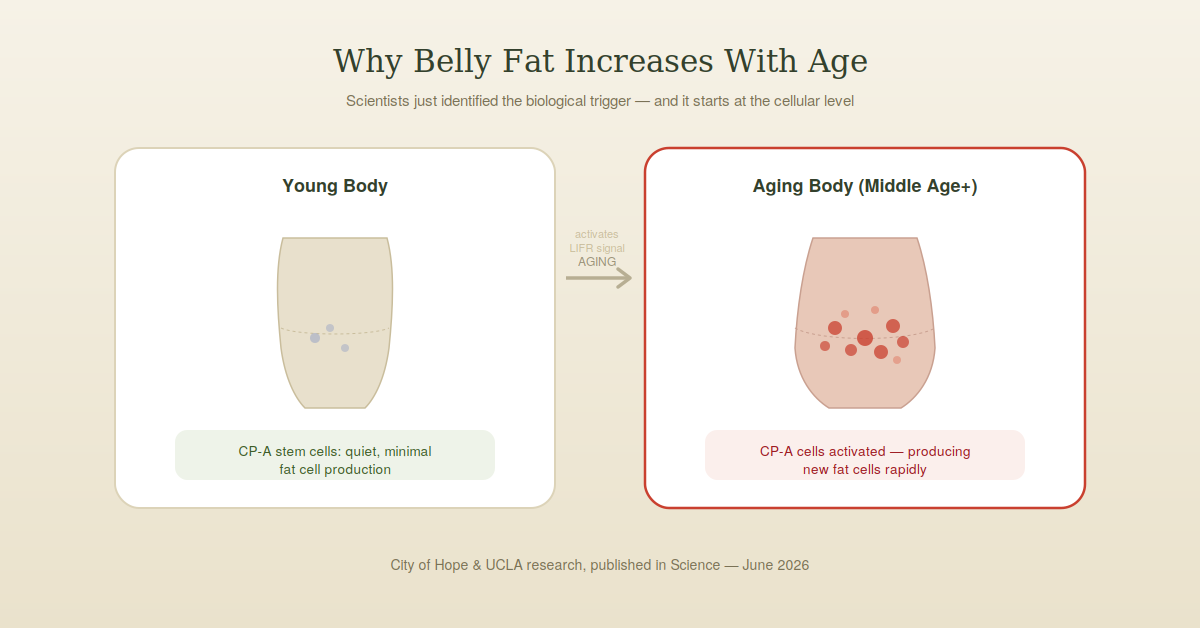
In younger bodies, these cells are relatively quiet. They exist, but they don’t generate large numbers of new fat cells at a rapid pace.
Researchers at City of Hope identified what may be a key biological driver of age-related belly fat. Their findings point to a newly identified type of stem cell that appears during aging and may help fuel the production of new fat cells. ScienceDaily
This newly identified cell type has been named CP-A — committed preadipocytes, age-specific. These cells are unique to the aging body and don’t appear in significant numbers in younger tissue. When aging begins, they emerge specifically in visceral fat tissue and begin converting into fat cells at a dramatically faster rate than anything seen in younger tissue.
The research team observed that male mice at 12 months of age — a stage equivalent to human middle age — experienced a dramatic increase in visceral adipose tissue. More than 80% of the fat cells in this tissue were newly generated, not simply enlarged. Conexiant
That’s a striking number. The belly isn’t just storing more fat in existing cells. It’s actively generating new ones — and aging is what switches that process on.
The Experiment That Confirmed It Wasn’t About Environment
One of the most compelling parts of this research is how the team confirmed that the CP-A cells themselves were responsible, rather than something about the aging body’s environment that might be triggering ordinary cells to behave differently.
The City of Hope team transplanted APCs from young and older mice into a second group of young mice. The APCs from the older animals rapidly generated a colossal amount of fat cells. When the team transplanted APCs from young mice into the older mice, however, the stem cells did not manufacture many new fat cells. SciTechDaily
This is an important distinction. The older stem cells carried their fat-producing behavior with them into a young host. The younger stem cells didn’t adopt the fat-producing behavior even when placed inside an older host.
In other words, the change is in the cells themselves — not just in the body they’re living in. That’s what makes this a genuinely new biological insight rather than a restatement of “aging bodies store more fat.”
The Signaling Pathway Behind It — and Why It Matters
The researchers didn’t stop at identifying the cells. They went a step further and identified the specific molecular signal that activates CP-A cells and drives their fat-producing behavior.
The leukemia inhibitory factor receptor, known as LIFR, was found to drive this fat-cell proliferation. Blocking LIFR in mice prevented the expansion of visceral fat, suggesting a potential therapeutic target for age-related obesity. Neuroscience News
LIFR is a receptor protein involved in several cellular signaling processes. In the context of these age-specific stem cells, it appears to function as the “on switch” that activates their fat-generating capacity.
The fact that blocking it in animal studies could prevent visceral fat expansion is significant — not because LIFR-blocking drugs are available or anywhere near clinical use, but because identifying a specific, targetable mechanism is the first step toward eventually being able to intervene in a precise way.
The discovery of CP-A as an age-specific cell population, along with the identification of LIFR signaling as a CP-A–specific mechanism, enhance understanding of the early aging process in fat tissue. Neuroscience News
Does This Happen in Humans Too
A natural question with any animal study is whether the same thing happens in human biology — and the researchers specifically checked this.
Researchers found similar cells in human tissue, suggesting the same process may occur in people. Men’s Journal
This doesn’t mean the human picture is fully mapped. The mechanism has been clearly demonstrated in mouse models and identified in human tissue samples, but large-scale human trials testing whether CP-A cells behave identically in people throughout the aging process haven’t been done yet. That’s the expected next step in this line of research.
What it does confirm is that the cellular machinery behind this finding isn’t unique to rodents — it appears to have a human equivalent, which is what makes this worth taking seriously as a finding with eventual real-world relevance.
What This Means for the “Eat Less, Exercise More” Narrative
One of the more practically important takeaways from this research is that it adds biological substance to something many people experience but have difficulty explaining.
The discovery identifies, for the first time, a specific cellular mechanism responsible for age-related abdominal fat accumulation — suggesting that the frustrating midlife experience of belly fat appearing despite consistent lifestyle habits is not simply a matter of willpower or reduced activity, but reflects a distinct biological process activated by aging. Medical Daily
This isn’t a get-out-of-jail-free card for poor lifestyle choices. Diet, movement, sleep, and stress management all still have measurable effects on visceral fat levels and can slow or partially counteract the process described here.
But it does mean that someone in their forties who is eating carefully and staying active, and still notices their midsection changing, is not imagining things or failing. A specific biological mechanism is working against them — one that didn’t exist in their younger body.
People often lose muscle and gain body fat as they age — even when their body weight remains the same, as the study’s co-corresponding author Qiong Wang noted. This research provides a specific reason why. ScienceDaily
What Actually Helps Reduce Visceral Fat Right Now
While LIFR-targeting therapies remain entirely in the research phase, several things have a reasonably solid evidence base for reducing visceral fat specifically, not just overall body weight.
Resistance training is one of the most consistently supported interventions specifically for visceral fat. Even when total body weight doesn’t change much, regular resistance exercise reduces visceral fat independently, likely through its effects on insulin sensitivity and metabolic rate.
Adequate sleep matters more for visceral fat than most people realise. Chronic sleep deprivation is specifically linked to visceral fat accumulation through cortisol dysregulation and disrupted appetite hormones, separately from calorie intake.
Reducing ultra-processed food has stronger support for reducing visceral fat than calorie reduction alone — likely because ultra-processed food drives the insulin dysregulation and chronic low-grade inflammation that visceral fat both causes and is caused by.
Managing chronic stress directly addresses cortisol, which preferentially drives fat storage in the visceral region. This is one of the more underappreciated levers specifically for belly fat rather than general weight.
None of these are new recommendations. But the new stem-cell research gives them a more specific biological context — you’re not just trying to burn calories, you’re working against a specific age-activated cellular process, which is a reason to be consistent rather than discouraged when progress feels slower than expected.
The Bottom Line
For the first time, researchers have identified a specific type of stem cell — CP-A cells — that appears during aging, activates through a signaling pathway called LIFR, and generates new fat cells specifically in the visceral abdominal region at a dramatically accelerated rate.
This explains, at a cellular level, why belly fat in middle age is qualitatively different from the weight changes of earlier life. It’s not purely about calories, activity levels, or discipline — it’s about a distinct biological mechanism that activates with aging and doesn’t have an equivalent in younger tissue.
Future therapies targeting LIFR or CP-A cells could eventually offer a more precise way to interrupt this process. For now, the practical takeaway is that the biology is real, it’s specific, and it’s working against you in a measurable way — which means the goal isn’t to wonder why standard advice isn’t working as well as it used to. It’s to work with the biology you actually have, rather than the one you had at 25.
This article is for informational purposes only and does not constitute medical advice. Consult a qualified healthcare provider before making changes to your diet, exercise routine, or lifestyle.