
Are wellness peptides safe? It’s a question more people are asking as peptide therapies move from specialist medical treatments into the mainstream wellness space. A few years ago, most people associated peptides with medications like insulin or GLP-1 drugs. Today, they’re being promoted for everything from faster muscle recovery and tendon healing to better sleep and anti-aging benefits. While the growing popularity of wellness peptides has sparked widespread interest, the scientific evidence hasn’t always kept pace with the marketing. Understanding what current research actually says is essential before deciding whether these products are safe or suitable for you.
A few years ago, “peptides” mostly meant insulin or GLP-1 medications to most people. Now it’s a whole wellness category of its own.
Vials and pens are marketed for healing tendons faster, sleeping deeper, recovering quicker, and quietly turning back the clock. They’re sold through anti-aging clinics, online “research chemical” suppliers, and an increasingly confident wellness-influencer ecosystem.
Popularity and evidence aren’t the same thing, though. Few corners of wellness right now have a wider gap between how confidently they’re marketed and how thin the actual human safety data is.
Here’s an honest look at the two most talked-about categories — BPC-157 and growth hormone secretagogues like CJC-1295 and ipamorelin — based on the regulatory record and the peer-reviewed research that actually exists, not the marketing built around it.
What “Wellness Peptides” Actually Means
Peptides are short chains of amino acids, smaller than full proteins, that act as signaling molecules in the body. Some peptide-based medications are genuinely well-established and FDA-approved — insulin and GLP-1 drugs like semaglutide are peptides too.
The “wellness peptide” category refers to a different, much less regulated group. This includes compounds like BPC-157, marketed for tissue repair, and growth hormone secretagogues like CJC-1295, ipamorelin, and sermorelin, marketed for anti-aging, fat loss, and recovery.
The crucial distinction that gets blurred in a lot of marketing: none of these are FDA-approved drugs for any of the purposes they’re being sold for. They occupy a regulatory gray zone — sometimes obtained through a prescribing physician and a compounding pharmacy, sometimes sold directly online as “research chemicals” explicitly labeled “not for human consumption.”
That label exists specifically because the seller hasn’t gone through the approval process required to legally market it for human use.
BPC-157 — What the Animal Research Shows
BPC-157, sometimes called “Body Protection Compound,” is derived from a protein found in human gastric juice. It’s been studied in animals, primarily Croatian rodent studies, since the 1990s.
The animal research is genuinely extensive. It has shown promising effects on wound healing, gut tissue, and inflammation in rats and mice over several decades of published studies.
BPC-157 — What the Human Research Shows
The human evidence tells a very different story. As of early 2026, only three small human studies of BPC-157 have been published, and the largest planned trial never reported results at all.
A 2015 Phase I study enrolled 42 healthy volunteers specifically to establish safety and pharmacokinetics in humans — the kind of foundational trial that’s supposed to come before any compound moves toward real medical use. In 2016, the sponsoring company cancelled the trial and never published any data, with no public explanation given.
What does exist is a 2025 pilot safety study giving intravenous BPC-157 to exactly two healthy adults, which found no measurable changes in cardiac, liver, kidney, or thyroid markers. This is cited fairly widely in peptide marketing as reassuring.
To their credit, the researchers behind it were upfront about its limits: two participants, no placebo group, and no way to separate a true drug effect from ordinary biological variability. Two people tolerating a substance without immediate harm is a genuinely useful first data point. It is not the same thing as established safety.
A small number of even smaller patient studies exist too, including a 2024 study of 12 patients with interstitial cystitis and a 2021 study of 16 patients with knee pain, both reporting positive results. These studies are small, lack placebo controls, and haven’t been independently replicated at scale.
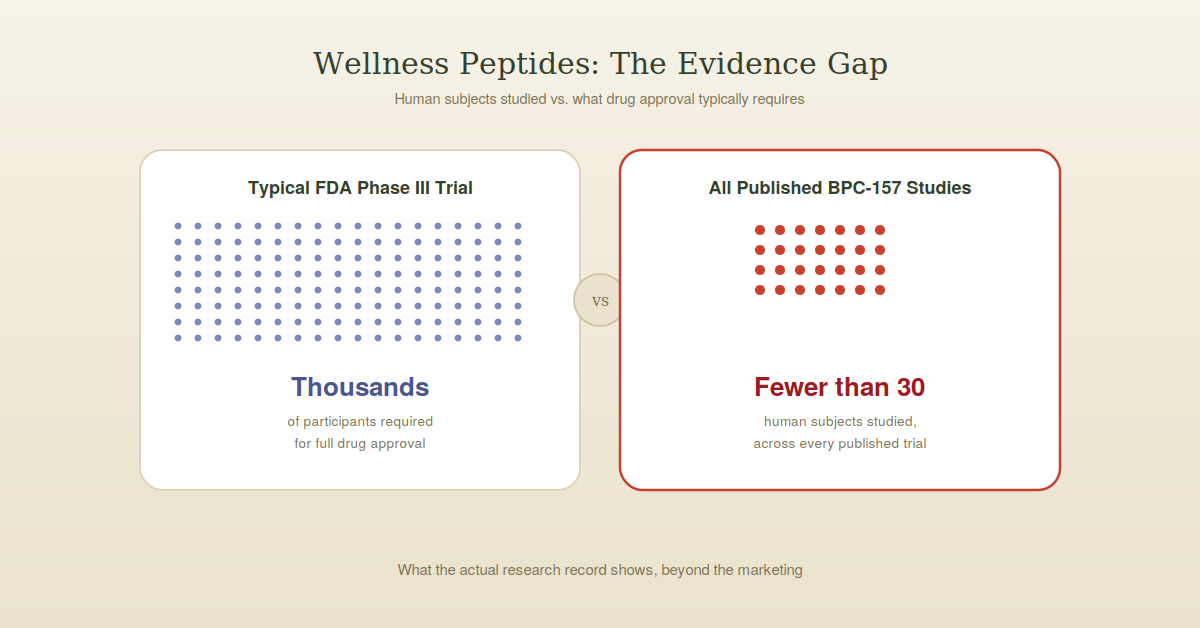
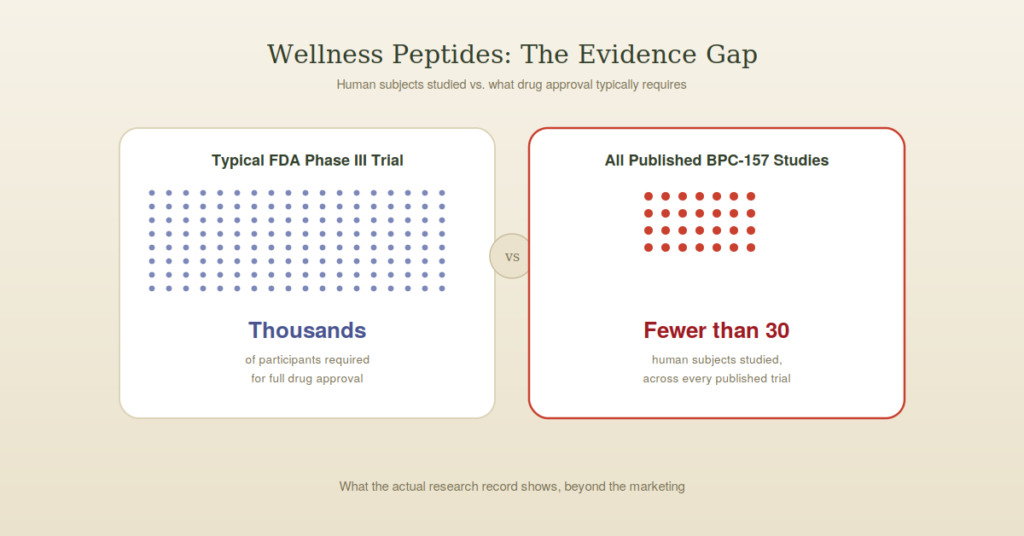
Total documented human subjects across all published BPC-157 research: fewer than 30 people. A typical Phase III drug trial for FDA approval involves thousands.
The Regulatory Status Is More Contradictory Than Marketing Suggests
BPC-157’s regulatory story adds another layer of complexity that wellness marketing tends to flatten into a simpler, more reassuring narrative than the facts support.
BPC-157 was added to the World Anti-Doping Agency’s prohibited substances list in 2022, then later removed from active prohibited status. Some sellers cite this as proof it’s “been cleared.” Critics note it simply reflects WADA’s own evolving classification process rather than a safety endorsement.
Separately, the U.S. Department of Defense lists BPC-157 as a prohibited dietary supplement ingredient for service members specifically. Products containing it are frequently labeled “research use only” — language that exists because the FDA has not approved it for human use, not as a quirky technicality.
There’s also active, ongoing scientific disagreement among researchers about BPC-157’s safety profile. A 2025 published exchange between research groups debated whether its effects on blood vessel formation could theoretically raise cancer or neurodegenerative disease risk, with one group defending the compound and another raising the concern.
When credentialed researchers are still debating basic mechanistic safety questions in peer-reviewed journals in 2025, that’s a meaningful signal about how unsettled this compound’s safety profile still is.
Growth Hormone Secretagogues — A Different Mechanism
CJC-1295 and ipamorelin work differently from BPC-157. Rather than acting directly on injured tissue, they stimulate the pituitary gland to release more of the body’s own growth hormone.
CJC-1295 mimics growth-hormone-releasing hormone, while ipamorelin mimics ghrelin and triggers a more immediate GH pulse. They’re commonly used together, marketed heavily for anti-aging, fat loss, muscle gain, and improved sleep.
The mechanism has a real, decades-old research basis. Human studies from 2006 and 2013 documented that small doses of CJC-1295 did measurably increase growth hormone secretion.
Why the FDA Restricted These Specific Peptides
Mechanism isn’t the same as a settled safety case for the uses being marketed, and the regulatory record here is genuinely concerning in a way that’s easy to miss in clinic marketing.
In October 2023, the FDA placed both CJC-1295 and ipamorelin into Category 2 of bulk drug substances — a classification that specifically prohibits licensed compounding pharmacies from preparing them for human use. The FDA’s stated rationale included safety concerns about heart-related adverse events in the available data.
Separately, the FDA has specifically warned about immunogenicity risk with both compounds, including the potential for life-threatening anaphylaxis, plus cardiovascular effects including increased heart rate and blood pressure drops tied specifically to CJC-1295.
As of early 2026, some reporting suggests regulatory movement toward reclassifying certain peptides back to a more permissive category. As of this writing, that remains an unsettled, evolving situation rather than a resolved one.
It’s also worth being direct about a basic finding common across multiple sources, including ones that otherwise market these peptides favorably: research into CJC-1295 specifically appears to have stalled after 2009 due to safety signals. As of February 2026, there were no active clinical trials for it listed on ClinicalTrials.gov at all.
A compound with no active human trials more than fifteen years after initial safety concerns emerged isn’t a compound with a thin but improving evidence base. It’s one where the research pipeline appears to have genuinely stopped.
Why “Well-Tolerated” Isn’t the Same as “Proven Safe”
A lot of peptide clinic marketing leans on language like “generally well-tolerated” or “favorable safety profile.” It’s worth understanding why that phrasing, while not necessarily false, doesn’t mean what it sounds like it means.
“Well-tolerated” typically describes the absence of severe, obvious adverse reactions in a small number of people who’ve used a compound and reported back, often informally. It doesn’t come from the kind of large, controlled, long-term studies needed to detect rarer risks or effects that take years to appear.
Cancer risk from elevated IGF-1 signaling is a specific concern raised about growth hormone secretagogues, by multiple sources including ones that otherwise sell these products. That’s exactly the kind of risk that wouldn’t necessarily show up in a few months of anecdotal use, but might take years of population-level data to properly evaluate.
The honest, current answer for both BPC-157 and the GH secretagogue class: nobody has done the research yet that would let anyone make a confident long-term safety claim either way.
There’s also a quality control issue layered on top. A 2025 peer-reviewed exchange challenged a competing research group’s claim of 99% peptide purity in their study material, noting that achieving genuinely verified purity at that level is exceptionally difficult even for expert peptide chemists. That concern applies with even more force to peptides purchased online as “research chemicals,” which typically come with no independent verification of purity or contents at all.
A Reasonable Way to Think About This
None of this means every claim about these compounds is false, or that the underlying biological mechanisms are nonsense. The animal research behind BPC-157 and the receptor pharmacology behind GH secretagogues are both genuinely real science.
What’s missing isn’t a plausible mechanism. It’s the large, controlled, long-term human research that would be required to confidently translate “this looks promising in mechanism and small studies” into “this is safe and effective for this specific use in people.”
If you’re considering either category, a few distinctions are worth holding onto. There’s a meaningful difference between a compound prescribed by a licensed physician through a regulated compounding pharmacy with documented medical rationale, and the same compound purchased online labeled “not for human consumption.” The legal and quality-control gap between those two paths is substantial, even though the underlying molecule might be identical.
There’s also a meaningful difference between “early human safety data looks reassuring” — roughly where BPC-157 sits, with real caveats — and “the FDA has actively restricted this due to specific safety concerns,” which is where CJC-1295 and ipamorelin currently sit. These are not the same risk category, despite often being marketed side by side as part of the same wellness trend.
The Bottom Line
Wellness peptides have grown into a genuinely large market faster than the human research needed to properly evaluate them has caught up.
BPC-157 has decades of promising animal data but fewer than 30 total human research subjects ever published, a cancelled and never-released major trial, and active scientific disagreement about its safety mechanism as recently as 2025. Growth hormone secretagogues like CJC-1295 and ipamorelin have a longer-established mechanism but were specifically restricted by FDA action in 2023 over safety concerns, with research into at least one of them appearing to have stalled for over a decade.
The honest, current state of the evidence for both categories is “promising mechanism, genuinely insufficient human safety data” — a meaningfully more cautious statement than the confident anti-aging and recovery claims found in most wellness peptide marketing.
If you’re considering either category, that gap is worth taking seriously. A conversation with a licensed physician who will discuss the actual regulatory status and evidence limitations, rather than only the potential benefits, is a reasonable minimum starting point.
Frequently Asked Questions: Are Wellness Peptides Safe
Is BPC-157 FDA approved?
No. BPC-157 is not approved by the FDA for any human use. It’s sometimes prescribed off-label by licensed physicians through compounding pharmacies, and sometimes sold online as a “research chemical” explicitly labeled “not for human consumption.”
Why were CJC-1295 and ipamorelin restricted by the FDA?
In October 2023, the FDA placed both into Category 2 of bulk drug substances, which prohibits compounding pharmacies from preparing them for human use. The agency cited safety concerns including potential heart-related adverse events and immunogenicity risk, including the possibility of severe allergic reactions.
Is BPC-157 safer than growth hormone secretagogues?
The two have different risk profiles rather than one being simply safer. Early human safety data on BPC-157 is limited but hasn’t shown major red flags so far, while CJC-1295 and ipamorelin have specific, named FDA safety concerns that led to active regulatory restriction. Neither has the kind of large-scale, long-term human research needed to make a confident safety claim either way.
Does “well-tolerated” mean a peptide is safe?
Not necessarily. That phrase usually describes the absence of obvious, immediate adverse reactions in a small number of users, not the result of large, controlled, long-term studies. Rarer risks or effects that take years to appear wouldn’t necessarily show up in that kind of informal safety record.
Are peptides sold online as “research chemicals” the same quality as what a doctor would prescribe?
Not reliably. Peptides obtained through a licensed physician and a regulated compounding pharmacy go through quality and purity oversight that online “research chemical” sellers typically don’t provide. Even peer-reviewed researchers have noted how difficult it is to verify peptide purity, which is a bigger concern for unregulated online sources.
This article is for informational purposes only and does not constitute medical advice. Wellness peptides including BPC-157, CJC-1295, and ipamorelin are not FDA-approved for the purposes commonly marketed, and CJC-1295 and ipamorelin are currently restricted from standard compounding due to FDA safety concerns. Please consult a licensed healthcare provider before considering any peptide therapy.