
Collagen has had a strange journey through the wellness world. It started as a skincare ingredient, promising firmer, more hydrated skin. Then it migrated into the joint health aisle, sold in the same tubs and sachets, now promising to ease creaky knees and support cartilage instead. That kind of crossover marketing can make a supplement feel like it’s chasing whatever’s trending rather than being backed by anything specific.
In collagen’s case, though, the joint health angle actually has a more developed body of clinical research behind it than you might expect — including a few genuinely new studies from 2025 and 2026. It also has a more honest, complicated story than most product pages let on, including a recent methodological critique questioning whether the existing trials are even big enough to draw firm conclusions from. Here’s what the research currently shows.
Why Collagen Specifically, and Not Just Any Protein
Collagen is the most abundant protein in the human body, making up as much as 30% of total protein mass, and it’s the primary structural component of cartilage, the tissue that cushions your joints. This is the basic logic behind collagen supplementation for joints: if cartilage is largely built from collagen, and cartilage breaks down with age and osteoarthritis, then supplying more collagen seems like a reasonable way to support the tissue.
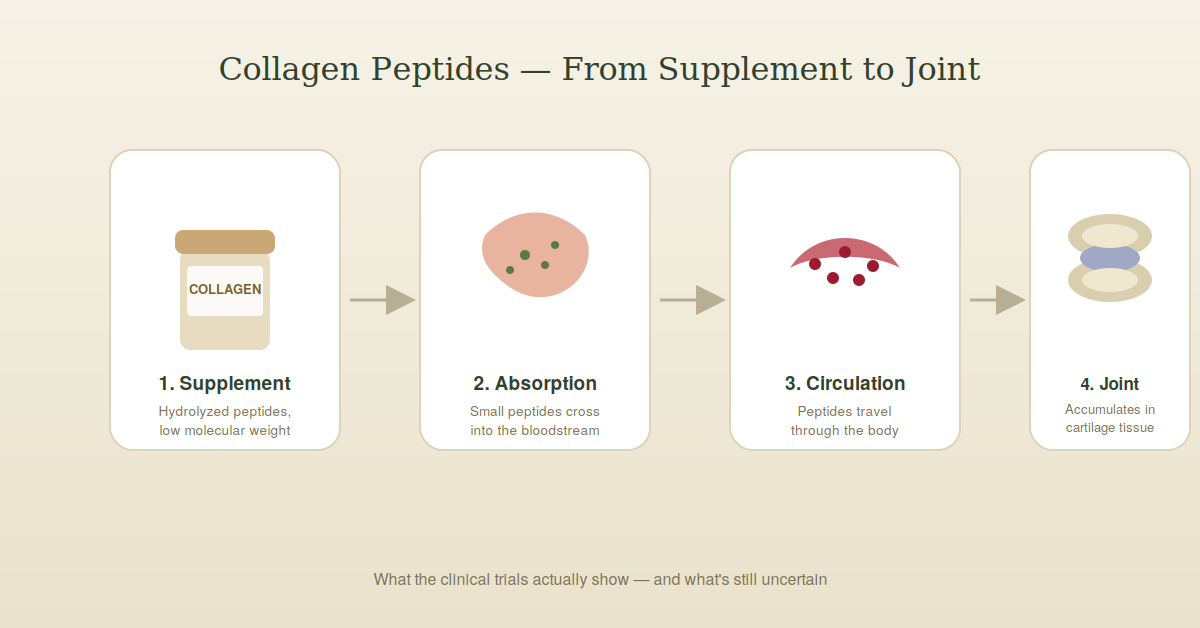
The actual mechanism researchers have proposed is more specific than just “supplying raw material,” though. When collagen is broken down into smaller peptides through a process called hydrolysis, these smaller fragments are absorbed through the intestinal wall into the bloodstream considerably more efficiently than intact collagen protein would be. From there, animal studies using radioactively labeled collagen have shown a notable and long-lasting accumulation specifically in cartilage tissue, at levels meaningfully higher than would be expected if the peptides were just circulating randomly throughout the body.
Once these peptides reach joint tissue, laboratory research suggests they interact with chondrocytes, the specialized cells responsible for producing new cartilage. The proposed effect is sometimes described as the body being prompted to respond as though its own collagen had broken down, triggering a repair signal that increases cartilage matrix production. This is a genuinely interesting and plausible mechanism — the question is how well it translates into measurable pain relief in actual human trials.
What the Human Trials Actually Show
This is where collagen has a real advantage over many joint supplements: there’s a reasonably active stream of human randomized controlled trials, including some quite recent ones.
A trial published in early 2025 gave adults with knee osteoarthritis either a collagen peptide supplement or a placebo and tracked both pain scores and inflammatory blood markers, including CRP. The collagen group showed measurable improvements in pain and function compared to placebo, alongside reductions in the inflammatory markers tracked.
A more rigorous and considerably longer trial published in late 2025 went further. Researchers gave 80 adults aged 40 to 75 with mild to moderate knee osteoarthritis either 3,000 mg of low-molecular-weight collagen peptides daily or a placebo, for a full 180 days — six months, which is a notably longer trial duration than much of the earlier collagen research. The collagen group showed significant reductions in WOMAC pain scores, the standard osteoarthritis assessment tool, along with improvements in physical function.
A separate meta-analysis pooling multiple randomized controlled trials specifically looking at collagen peptide’s pain-relieving effect in knee osteoarthritis found a consistent analgesic benefit across the studies reviewed, with a generally favorable safety profile and minimal adverse events reported.
The Important Caveat Most Collagen Marketing Leaves Out
Here’s the part of the story that genuinely matters, and it’s recent enough that most articles and product pages haven’t caught up to it yet.
A formal commentary published in late 2025, responding directly to the 180-day trial described above, raised a more fundamental question about the entire body of collagen-for-osteoarthritis research: are these trials even large enough to reliably detect a real effect, or rule one out? The commentary specifically called for future research to use more rigorous randomization methods, pre-specified statistical analysis plans, and direct head-to-head comparisons against established treatments like NSAIDs, rather than comparing collagen only to an inactive placebo.
This concern was echoed by an even more pointed line of research: a trial sequential meta-analysis, a statistical method specifically designed to ask whether enough total patients have been studied across all available trials combined to draw a truly confident conclusion. That analysis found that, despite collagen’s reasonably large research base compared to other joint supplements, the cumulative number of patients studied may still fall short of what’s needed for high statistical confidence in the size of the effect.
In plain terms: the trials that exist mostly point in a positive direction, but researchers studying this area themselves are saying it’s premature to call the evidence settled. This is a meaningfully more honest position than either “collagen is proven to work” or “collagen is a scam” — it’s somewhere in the more academically careful middle, which is a less satisfying answer but a more accurate one.
Read more How to Reduce Stress Naturally Without Medication: 12 Practical Ways That Actually Work
Does the Type of Collagen Matter
It does, and this is one of the more practically useful details buried in the research.
Molecular weight is the most consistently important factor. Research comparing collagen hydrolysate with different peptide sizes has found that smaller peptides, generally those under 3,000 Daltons, are absorbed into the bloodstream considerably more efficiently than larger collagen fragments or whole gelatin. One comparison study found absorption of a key collagen-derived compound was nearly twice as high with smaller, more processed peptides compared to standard gelatin. If you’re choosing a product, this is the detail to look for on the label, even though it’s a slightly technical one — terms like “hydrolyzed collagen” or “low molecular weight collagen peptides” generally signal this processing, while plain “gelatin” or “collagen protein” typically does not.
Type II collagen specifically targets cartilage composition more directly, since cartilage is predominantly made of type II collagen, whereas the more commonly sold type I and type III collagen (often marketed primarily for skin) are more abundant in skin, bone, and other connective tissue. Some research has specifically explored type II collagen for joint applications based on this compositional match, though type I collagen peptides have also shown positive results in the osteoarthritis trials described above, so this distinction may matter less in practice than the marketing around it suggests.
Dosing in the actual trials clustered around 3,000 to 10,000 mg daily, generally taken once a day, with most studies running for at least two to three months before measuring outcomes — meaning this isn’t a fast-acting supplement, and judging it after a week or two isn’t a fair test based on how the research itself was designed.
What About Collagen for Skin Versus Joints — Is It the Same Product
This is a fair question, since collagen supplements are frequently marketed for both skin and joints using very similar packaging and language.
The honest answer is that the absorption and signaling mechanism appears broadly similar — hydrolyzed collagen peptides circulate through the bloodstream and can reach multiple tissues, including both skin and cartilage, where they may stimulate the relevant local cells, fibroblasts in skin and chondrocytes in joints, respectively. Some research has specifically explored combining different collagen types to potentially capture complementary effects across tissues.
That said, the clinical trials demonstrating joint benefit specifically used joint-focused dosing and the molecular weight ranges described above, generally over several months. A product marketed primarily for skin hydration, taken at a lower dose primarily aimed at cosmetic outcomes, isn’t necessarily tested at the same dose or duration as what the osteoarthritis trials used, so the same bottle may not deliver an equivalent joint benefit simply because it contains the word “collagen.”
Safety and Who Should Be Cautious
Across the trials reviewed, collagen peptide supplementation has shown a generally favorable safety profile, with minimal and typically mild adverse events reported, mostly limited to occasional digestive discomfort.
People with shellfish or fish allergies should check the source of any collagen supplement carefully, since marine-derived collagen is increasingly common and could trigger a reaction in people with those specific allergies. People taking medication for chronic conditions, or managing other health concerns, should still mention any new supplement, including collagen, to their doctor, both as routine good practice and specifically because joint pain itself sometimes has underlying causes that are worth ruling out rather than simply treating with a supplement.
Read more Prebiotics vs Probiotics: What’s the Difference and Which One Does Your Gut Need?
A Reasonable Way to Think About This
Given everything above, collagen for joint pain sits in a genuinely reasonable, if not definitively settled, place in the evidence hierarchy. It has more clinical trial support, including a meaningful 2025 six-month trial, than many other natural joint remedies, and a plausible, partially demonstrated biological mechanism behind it. At the same time, the researchers most closely involved in this specific field are themselves flagging that the total evidence base may not yet be large enough for full confidence in exactly how strong the effect is.
A practical approach, if you’re considering it: choose a hydrolyzed or low-molecular-weight collagen peptide product specifically, expect to commit to at least two to three months before judging whether it’s helping, since that’s the timeframe the actual trials used, and treat it as one reasonable option among several rather than a guaranteed fix — pairing it, where appropriate, with the movement, weight management, and anti-inflammatory dietary approaches that have their own separate and often stronger supporting evidence for joint health.
The Bottom Line
Collagen supplements for joint pain are backed by more than marketing alone — there’s a real, growing body of randomized controlled trials, including recent ones specifically measuring knee osteoarthritis pain and function over meaningful timeframes, with generally positive results and a plausible biological explanation for why it might work.
The honest caveat, and one worth taking seriously rather than glossing over, is that the researchers working most closely in this area have recently and explicitly questioned whether the existing trials are large enough to settle the question definitively. That’s a normal and healthy part of how evidence matures over time, not a reason to dismiss collagen outright — but it is a reason to hold the claim with appropriate, measured confidence rather than the certainty a product label might suggest.
This article is for informational purposes only and does not constitute medical advice. Please consult a healthcare professional before starting any new supplement, particularly if you have allergies, take regular medication, or have an underlying joint or health condition.