
Finding more hair than usual in the shower drain, on your pillow, or wrapped around your hairbrush is one of those things that’s hard not to notice — and hard not to worry about.
The good news is that most hair loss has a cause you can actually identify. And most of those causes are either treatable, temporary, or both.
The first thing worth knowing is that losing between 50 and 100 hairs a day is completely normal. Your hair grows in cycles — it grows, it rests, and then it sheds so a new hair can take its place. Problems start when more hairs than usual go into the shedding phase at once, when new growth slows down, or when follicles begin to shrink over time.
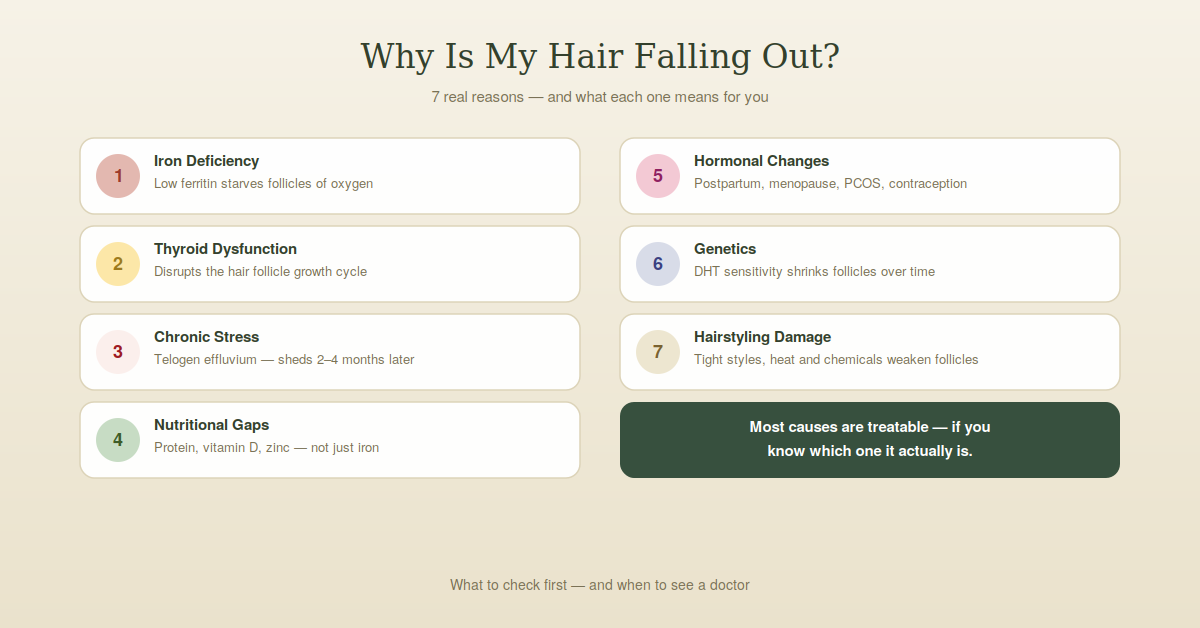
Here are the most common reasons that happens — and what you can do about each one.
1. Iron Deficiency — The Most Overlooked Cause in Women
If you’re a woman and your hair has been thinning gradually, iron should be the first thing you check.
Iron is essential for producing haemoglobin, which carries oxygen to your hair follicles. Without enough of it, your follicles don’t get the oxygen they need to stay in the active growth phase. The result is more hairs shifting into the resting and shedding phase than normal.
The sneaky part is that you can have iron deficiency affecting your hair without feeling classically anaemic. The lab value that matters most for hair is ferritin — your stored iron — rather than just haemoglobin. Many women are told their iron is “fine” based on haemoglobin alone, while their ferritin sits at a level too low to support healthy hair growth.
Heavy periods, plant-based diets, and any condition affecting nutrient absorption all raise the risk.
What to do: Ask your doctor for a full iron panel including ferritin specifically. Don’t supplement iron without testing first — too much iron causes its own problems. If deficiency is confirmed, dietary iron from red meat, lentils, and dark leafy greens alongside a good supplement can make a meaningful difference, though hair regrowth takes three to six months to become visible.
2. Thyroid Problems — When Your Body’s Thermostat Goes Wrong
Both an overactive and underactive thyroid can cause your hair to fall out, and the pattern is usually diffuse thinning across the whole scalp rather than bald patches.
Your thyroid hormones regulate how quickly your cells turn over — including the cells in your hair follicles. When those hormones are off in either direction, follicles can’t maintain their normal growth rhythm. They shed faster than they replace.
Hypothyroidism, an underactive thyroid, is the more common culprit. It’s easy to miss because the symptoms creep up gradually — persistent fatigue, feeling cold all the time, dry skin, constipation, low mood. Hair thinning is usually one of several signs rather than appearing in isolation.
The reassuring thing about thyroid-related hair loss is that once the thyroid condition is properly treated and hormone levels stabilise, hair typically regrows. It’s not permanent.
What to do: A TSH blood test at your next routine check-up is all it takes to screen for thyroid dysfunction. If you have several of the symptoms above alongside hair thinning, mention all of them to your doctor — thyroid issues are extremely treatable once identified.
3. Chronic Stress — The Delayed Effect Most People Miss
When you go through a period of intense stress — a bereavement, a serious illness, a major surgery, a prolonged difficult time at work — you might notice your hair starting to fall out a few months later.
This isn’t immediately obvious as stress-related because of the time lag. The condition is called telogen effluvium, and it happens when a stressful event pushes a larger-than-usual number of hair follicles into the resting phase all at once. Two to four months later, those hairs shed simultaneously.
The result can feel alarming — sudden, noticeable hair loss that seems to come out of nowhere. But here’s the important thing: telogen effluvium is almost always temporary. Once the trigger is resolved and stress levels decrease, the growth cycle resets itself. Most people see full regrowth within six to nine months.
Chronic ongoing stress is a different matter. If the pressure never fully lifts, cortisol stays elevated and the cycle keeps repeating, which is why managing stress isn’t just good for mental health — it has direct physical effects on your hair.
What to do: If you’ve had a stressful period two to three months before the hair loss started, this is likely the cause. Support your body with good sleep, adequate protein, and stress management. If the shedding is severe or persists beyond nine months, see a dermatologist.
4. Nutritional Deficiencies Beyond Iron
Iron gets most of the attention, but several other nutritional gaps can trigger hair loss — and they’re worth knowing about, particularly if you follow a restricted diet.
Protein is the building block of hair itself. Hair is made of keratin, which is a protein. When protein intake is consistently too low — whether from a very restrictive diet or significant calorie reduction — your body prioritises protein for essential organs and deprioritises hair growth. This is one reason crash diets often cause noticeable hair shedding a few months after the restriction period.
Vitamin D deficiency has been repeatedly linked to hair thinning. Vitamin D receptors play a role in the hair follicle cycle, and low levels appear to disrupt normal growth and shedding patterns. Given that vitamin D deficiency is one of the most common nutritional deficiencies in adults, this is worth checking if other causes have been ruled out.
Zinc plays a role in hair tissue growth and repair, and keeps the oil glands around follicles working properly. Deficiency is associated with hair loss, and it’s common in people who eat very little meat or shellfish.
Biotin is one of the most heavily marketed nutrients for hair — but actual biotin deficiency causing hair loss is genuinely rare. Most people get plenty through diet. Biotin supplements are unlikely to help unless you’re specifically deficient, which is uncommon.
What to do: A blood panel checking vitamin D, zinc, B12, and ferritin alongside your standard iron panel gives you a clear picture of where the gaps are. Eat enough protein — a palm-sized portion of protein at each meal is a reasonable starting point.
5. Hormonal Changes — Particularly for Women
Women’s hair is deeply sensitive to hormonal shifts, and there are several points in life where these changes commonly trigger shedding.
Postpartum hair loss is one of the most dramatic and alarming — and one of the most temporary. During pregnancy, high oestrogen levels keep hairs in the growth phase longer than usual, which is why many women have noticeably fuller hair while pregnant. After delivery, oestrogen drops sharply, and all those extra hairs shed at once. It peaks around three to four months postpartum and is almost always resolved within a year.
Menopause brings a gradual shift in the oestrogen-to-androgen ratio that can cause female pattern hair loss — diffuse thinning, particularly at the crown and along the parting. Unlike postpartum loss, this is a longer-term change that may need active management.
PCOS (polycystic ovary syndrome) elevates androgen levels, which can cause hair on the scalp to thin while hair on the face and body may increase. It’s one of the more common causes of hair loss in younger women.
Hormonal contraception can sometimes trigger hair loss, particularly in women who are genetically predisposed to hormone-related hair thinning. Some women also experience a shedding phase after stopping the pill, as oestrogen levels drop.
What to do: If hormonal causes are suspected, a doctor can check oestrogen, testosterone, DHEA-S, and other hormone markers alongside a general blood panel. Treatment depends on the specific hormonal picture and can range from dietary support to medication.
6. Genetics — The Most Common Cause Overall
Male and female pattern hair loss is the most common cause of hair loss worldwide, affecting the majority of men and a significant number of women too.
In men, it typically shows up as a receding hairline and thinning at the crown. In women, it’s usually diffuse thinning across the top of the scalp with the frontal hairline largely preserved.
It’s driven by a sensitivity to DHT — a hormone derived from testosterone — which gradually shrinks hair follicles over time. This sensitivity is inherited, which is why it tends to run in families on both sides.
Genetic hair loss isn’t reversible in the traditional sense, but it is manageable. The earlier it’s identified, the more options are available to slow or halt progression.
What to do: If hair loss follows a pattern, runs in your family, and isn’t explained by the other causes above, genetic hair loss is likely playing a role. A dermatologist can confirm this and discuss options including topical minoxidil, finasteride, and other treatments that have solid evidence behind them.
7. Hairstyling Habits That Damage Over Time
This one doesn’t get enough attention, particularly for women with naturally textured or curly hair.
Hairstyles that pull consistently on the follicles — tight ponytails, buns, braids, extensions — can cause a type of hair loss called traction alopecia. Done repeatedly over years, the pulling eventually damages the follicles permanently along the hairline, which is why this type of loss tends to show up at the temples and edges first.
Heat tools, chemical treatments, and bleaching don’t cause hair loss from the follicle — but they cause breakage along the hair shaft, which can make hair appear thinner and shorter than it should be.
What to do: Vary your hairstyles, avoid tight styles worn daily, and use heat tools at lower temperatures. For breakage, deep conditioning treatments and gentle handling of wet hair make a real difference over time.
When to See a Doctor
Some hair shedding is normal and resolves on its own. But there are specific situations where getting checked sooner rather than later makes sense.
See a doctor if your hair loss is sudden and significant, if it’s accompanied by other symptoms like fatigue, weight changes, or skin changes, if you’re finding patches of missing hair rather than general thinning, or if it’s been going on for more than six months without any clear cause.
Early diagnosis usually means more options. Hair follicles that are damaged or dormant for too long become harder to revive, so waiting isn’t usually the best strategy.
The Bottom Line
Most hair loss has a reason — and most reasons are either treatable or temporary.
The most common causes are iron deficiency, thyroid dysfunction, stress-related shedding, hormonal shifts, and nutritional gaps — all of which show up on a standard blood panel. Genetic hair loss is the most common overall but also the most manageable when caught early.
The key is identifying which of these applies to you rather than guessing. A blood test is almost always the right starting point, and it’s a conversation any doctor will take seriously.
This article is for informational purposes only and does not constitute medical advice. If you are experiencing significant hair loss, please consult a healthcare professional or dermatologist for a proper diagnosis and personalised treatment plan.