
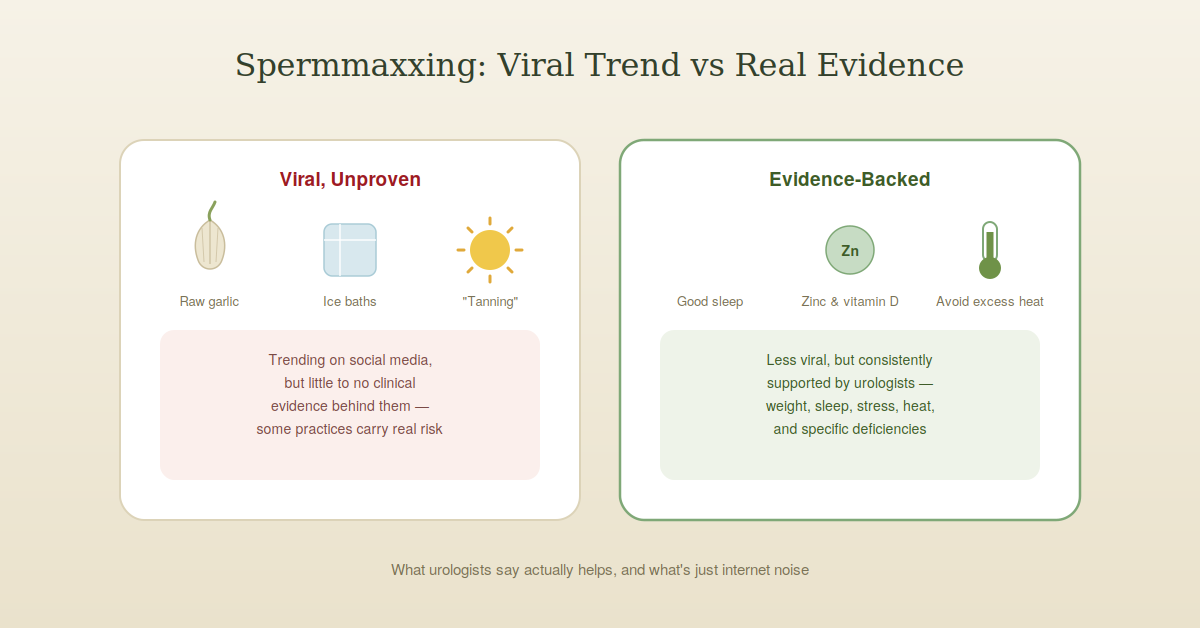
What is spermmaxxing? The term has recently started appearing across social media and online wellness communities, where it refers to a collection of habits and lifestyle changes claimed to improve sperm quality, fertility, testosterone, or overall male reproductive health. Some of the advice involves sensible basics such as getting enough sleep, exercising regularly, maintaining a healthy weight, and avoiding smoking, while other recommendations have little scientific evidence behind them. So, does spermmaxxing actually work? The answer depends on which specific practice you’re talking about—and separating evidence-based fertility advice from internet hype is essential.
If you’ve spent any time on men’s health TikTok or Reddit recently, you’ve probably run into the term. Spermmaxxing — the practice of trying to optimize sperm count, quality, and overall fertility through diet, lifestyle, supplements, and sometimes genuinely strange rituals — has gone from niche slang to a full-blown social media movement in 2026. Some of it is sensible. Some of it involves dipping your testicles in ice water. A few of the more extreme versions are, according to actual urologists, mildly dangerous.
Here’s what’s driving this trend, what’s worth taking seriously, and what’s just internet noise dressed up as biohacking.
What Spermmaxxing Actually Means
The term borrows its structure from “looksmaxxing,” an earlier and similarly online-born trend focused on optimizing physical appearance. “Maxxing” has since attached itself to almost anything — there’s fibermaxxing, even “ballmaxxing” — and spermmaxxing is the fertility-focused branch of that same internet impulse: the relentless, often supplement-heavy pursuit of maximizing reproductive health, tracked and shared the way people now track sleep scores or step counts.
Unlike most fertility content historically aimed at women, spermmaxxing represents a genuinely new cultural moment — men proactively engaging with their own reproductive health before any diagnosis of infertility, rather than only after struggling to conceive.
Why This Trend Exists at All
The anxiety behind spermmaxxing isn’t manufactured out of nothing. Dr. Philip Werthman, a board-certified urologist and men’s health specialist, told Healthline that meta-analyses show sperm counts in Western men have dropped roughly 50 to 60% over the past four to five decades — a trend he describes plainly as “not noise, that’s a signal.” He points to multiple likely contributing factors working together, including endocrine-disrupting chemicals like phthalates and BPA, diets heavy in ultra-processed food, sedentary lifestyles, and chronic stress.
At the same time, there’s a real and longstanding gap in how seriously male fertility has been treated within mainstream medicine. A report highlighted by The Guardian found that more than 80% of doctors had received no formal education on male fertility, and nearly all would struggle to properly assess for varicocele, a common, treatable condition affecting sperm production. Werthman is direct about what this has created: “These trends fill a vacuum that medicine has created by largely ignoring male fertility… that’s a failure on our part as much as anything else.”
Male factor contributes to roughly 40 to 50% of infertility cases overall, a statistic that runs directly against the common assumption that fertility struggles are primarily a female issue.
The Practices That Are Mostly Harmless Internet Noise
Several spermmaxxing rituals circulating online range from pointless to actively counterproductive, according to the urologists who’ve been asked to weigh in on the trend.
Eating raw garlic has become something of a spermmaxxing signature, alongside other folk-remedy style additions to the diet. There’s no meaningful clinical evidence this moves sperm parameters in any measurable way on its own.
Testicular ice baths are based on the legitimate underlying fact that the testicles function best slightly cooler than core body temperature — but dunking them in ice water isn’t how that principle translates into anything useful. Werthman was blunt about this category of practice: “Raw garlic and ice baths for your testicles aren’t going to move the needle in any meaningful clinical way.”
Testicle tanning, a more extreme practice that has gained some traction, is a genuine concern rather than just an ineffective fad. Experts have warned this practice may actually reduce sperm counts and increase the risk of testicular tumors — making it one of the few spermmaxxing trends that crosses from “probably useless” into “possibly harmful.”
Prolonged abstinence before trying to conceive is another common misconception worth correcting directly. While two to five days of abstinence can modestly increase sperm volume, prolonged abstinence beyond about a week tends to decrease sperm quality, increasing the percentage of dead sperm and DNA fragmentation due to oxidative stress — the opposite of what many men assume “saving up” accomplishes.
What Urologists Say Actually Helps
Strip away the viral gimmicks, and the genuinely evidence-supported recommendations for sperm health are less exciting, but considerably more useful.
Maintaining a healthy weight is one of the most consistently cited factors, since excess body fat is linked to hormonal changes that can impair sperm production. Reducing alcohol and cannabis use, and quitting smoking, all have reasonably consistent research support for improving sperm parameters over time. Getting sufficient sleep and managing chronic stress matter as well, both through their broader hormonal effects on the body.
Heat exposure deserves specific attention, since it’s one of the more overlooked, evidence-grounded factors. The testicles sit outside the body specifically because sperm production requires a temperature meaningfully cooler than core body temperature. Practical advice here includes avoiding frequent hot tub or sauna use during active attempts to conceive, and being mindful of laptops resting directly on the lap for extended periods, both of which raise local temperature in ways that can measurably affect sperm production over the resulting weeks.
Addressing specific nutritional deficiencies, particularly zinc and vitamin D, has real research behind it, though specifically for people who are actually deficient rather than as a blanket recommendation to supplement regardless of baseline levels. Among the popular spermmaxxing supplements, zinc has a legitimate, well-established role in sperm production, and CoQ10 has been studied with some promising results specifically for sperm motility. Other commonly stacked supplements, including ashwagandha and Tongkat Ali, have far less consistent research behind them, often resting on small or early studies that haven’t been widely replicated.
A semen analysis is the recommended starting point experts consistently point back to, rather than guessing your way through a stack of supplements without knowing your actual baseline parameters.
Why the 90-Day Timeline Actually Matters Biologically
One detail that does hold up well scientifically, regardless of how it’s being marketed, is the timeline involved in sperm production, known as spermatogenesis. It takes roughly 74 days for a sperm cell to fully develop in the testicles, followed by an additional two weeks or so to mature and travel through the reproductive tract — creating an effective cycle of approximately 90 days from lifestyle input to measurable output.
This means the sperm being produced today reflects lifestyle choices, diet, heat exposure, and stress from roughly three months earlier. It’s a genuinely useful piece of context, because it explains why short-term efforts, like a single weekend of “eating clean” or one cold plunge, won’t show up on a semen analysis in any meaningful way. Real change requires sustained habits over a full cycle, not a quick intervention right before testing.
Common Misconceptions Worth Correcting
A few specific myths come up repeatedly in spermmaxxing content, and they’re worth addressing directly because believing them can lead to real harm.
The idea that fertility is primarily a female issue ignores that male factor contributes to roughly half of all infertility cases, as covered above. The idea that sperm count is the only thing that matters overlooks that morphology, the shape of sperm cells, and motility, how well they move, are equally important — a high count paired with poor motility or abnormal shape can still mean significantly compromised fertility. The assumption that being young automatically means good fertility is also misleading, since sperm quality begins gradually declining in the late 20s, with the cumulative impact of lifestyle factors building over time rather than appearing suddenly.
Perhaps most importantly: the belief that testosterone supplementation improves fertility is backwards. It does the opposite. Exogenous testosterone suppresses the body’s natural hormonal signaling along what’s called the HPG axis, and can cause azoospermia, a complete absence of sperm in the ejaculate. Werthman specifically flagged this as one of the more clinically harmful misconceptions, since men sometimes self-medicate with testosterone replacement therapy while actively trying to conceive, working directly against their own goal.
Is This Trend Actually a Bad Thing
Despite the questionable rituals and the influencers monetizing fertility anxiety along the way, several experts interviewed across multiple outlets have made a similar point: the underlying shift toward men engaging seriously with their reproductive health isn’t inherently negative, even if the social media packaging around it often is.
Dr. Allison Rodgers, a medical advisor at a fertility clinic, suggested the trend is more likely to evolve into something resembling ongoing biohacking than disappear as a short-lived fad, predicting a gradual shift away from social media gimmicks and toward holistic, research-backed approaches, alongside a hope that fertility testing eventually becomes as routine as standard annual bloodwork rather than something men rarely access.
The most legitimate version of this trend treats spermmaxxing less as a collection of viral hacks and more as overdue attention to a part of reproductive health that mainstream medicine has historically underserved.
The Bottom Line
Spermmaxxing is a mix of two very different things wearing the same trendy name. One part is a legitimate, overdue cultural shift toward men taking male fertility seriously, grounded in a real and well-documented decline in sperm counts over recent decades. The other part is a wave of unproven and occasionally risky rituals, amplified by influencers who benefit from engagement regardless of whether the advice actually works.
The genuinely useful version of this trend looks far less exciting than the viral one: maintaining a healthy weight, moderating alcohol and avoiding smoking, managing heat exposure and stress, addressing actual nutrient deficiencies rather than guessing, and starting with a semen analysis rather than a supplement stack. None of that performs well on TikTok. All of it has considerably more evidence behind it than raw garlic or an ice bath ever will.
Frequently Asked Questions
Does eating raw garlic actually improve sperm count?
There’s no meaningful clinical evidence that eating raw garlic affects sperm count, motility, or quality in any measurable way. It’s one of the more popular spermmaxxing rituals online, but it hasn’t been shown to move the needle clinically.
Is testicle tanning safe?
No. Experts warn this practice may actually reduce sperm counts and increase the risk of testicular tumors, making it one of the few spermmaxxing trends that carries real potential harm rather than simply being ineffective.
Does taking testosterone supplements help with fertility?
No, it does the opposite. Exogenous testosterone suppresses the body’s natural hormonal signaling and can cause azoospermia, a complete absence of sperm in the ejaculate. This is one of the most clinically significant misconceptions in the spermmaxxing trend, since men sometimes use testosterone replacement therapy while actively trying to conceive, working directly against their own goal.
How long does it take to see results from lifestyle changes?
Sperm production, or spermatogenesis, takes roughly 74 days to fully develop, plus around two more weeks to mature, creating an effective 90-day cycle. This means a semen analysis today reflects lifestyle habits from about three months earlier, so meaningful change requires sustained habits over a full cycle, not a quick fix right before testing.
Should men get a semen analysis even without a known fertility problem?
Experts interviewed on this trend generally recommend it as a sensible starting point, since it provides an actual baseline rather than guessing through a stack of supplements. Some specialists have suggested fertility testing could reasonably become as routine as standard annual bloodwork going forward.
This article is for informational purposes only and does not constitute medical advice. If you have concerns about fertility, please consult a urologist or reproductive health specialist, particularly before starting any supplement regimen or hormone therapy.