
What is psoriasis — and why, no matter what you do, does it seem to always return?
If you’ve been dealing with psoriasis for any length of time, this is probably the question that frustrates you most. You manage a flare, the skin clears, and then weeks or months later it’s back. Sometimes worse than before. Sometimes in a new area. Often triggered by something you can’t quite pin down.
Understanding why this happens starts with understanding what psoriasis actually is at a biological level — because it’s not simply a skin condition, even though the skin is where it shows up.
What Psoriasis Actually Is
Psoriasis is a chronic autoimmune condition. That distinction — autoimmune — is the key to understanding everything else about it.
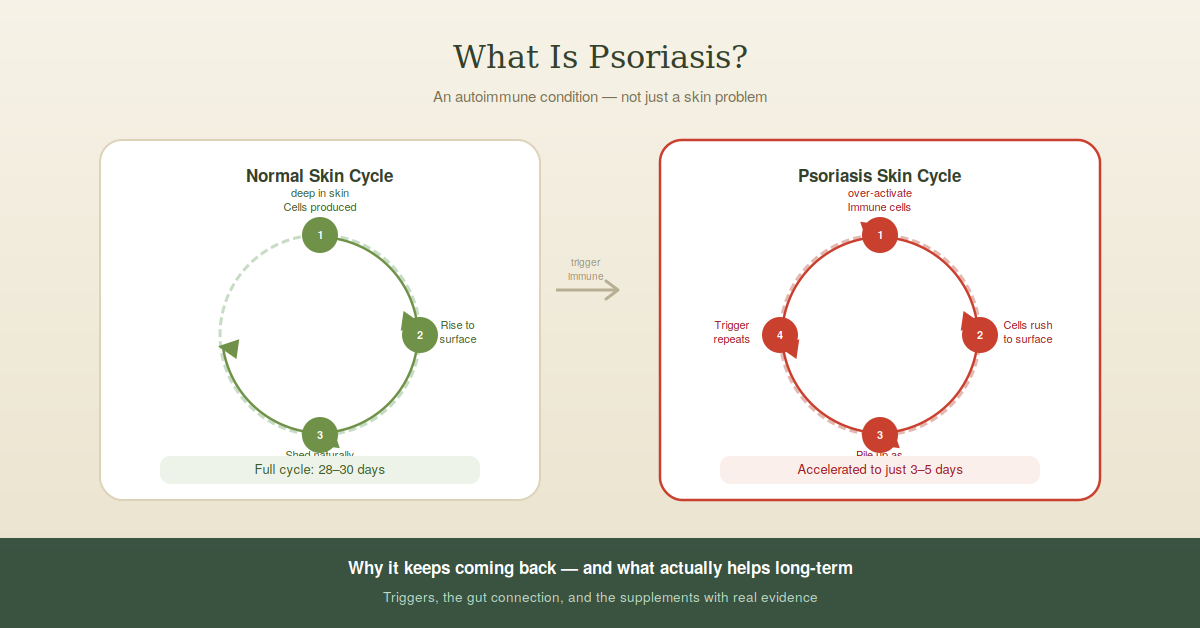
In a normal, healthy skin cycle, skin cells are produced in the deeper layers, travel to the surface over roughly 28 to 30 days, and then shed naturally. You don’t notice this process because it happens gradually and invisibly.
In psoriasis, that cycle is drastically accelerated. The immune system mistakenly signals skin cells to reproduce at a dramatically faster rate — cycling through in just three to five days instead of the usual 28 to 30. The skin cells arrive at the surface far faster than they can be shed, and they pile up into the raised, red, scaly plaques that characterise the condition.
This isn’t a surface problem that a cream will permanently fix. It’s an immune system problem that expresses itself on the skin. Which is why treatment that targets only the skin surface can reduce plaques temporarily but doesn’t address the underlying immune dysregulation driving them.
The Different Types of Psoriasis
Not all psoriasis looks the same, and knowing which type you’re dealing with helps explain the specific pattern you’re experiencing.
| Type | What It Looks Like | Where It Appears |
|---|---|---|
| Plaque psoriasis | Raised, red patches covered in silvery-white scales | Elbows, knees, scalp, lower back — most common (80-90% of cases) |
| Scalp psoriasis | Scaling and redness on the scalp, sometimes extending to the forehead | Scalp, hairline, behind ears |
| Guttate psoriasis | Small, drop-shaped spots | Trunk, arms, legs — often triggered by strep throat |
| Inverse psoriasis | Smooth, red patches without scales | Skin folds — armpits, groin, under breasts |
| Pustular psoriasis | White pustules surrounded by red skin | Hands and feet, or widespread |
| Nail psoriasis | Pitting, discolouration, thickening of nails | Fingernails and toenails |
| Psoriatic arthritis | Joint pain, stiffness, swelling alongside skin symptoms | Joints — affects up to 30% of people with psoriasis |
Plaque psoriasis is by far the most common form. But many people have more than one type simultaneously, and types can change or overlap over time.
Why Psoriasis Is an Immune System Condition
This is the part most people haven’t been clearly told, and it changes how you think about managing the condition.
In psoriasis, a specific type of immune cell called a T-cell becomes overactive and begins attacking healthy skin cells as though they were a threat. This triggers an inflammatory cascade — the body’s response to what it perceives as an attack — which includes the signal to rapidly produce more skin cells.
Two inflammatory proteins play a central role in this process: TNF-alpha (tumour necrosis factor) and IL-17 (interleukin-17). These are the targets of many modern psoriasis biologic treatments, which work by blocking these specific inflammatory signals rather than suppressing the immune system broadly.
Why does the immune system behave this way? The full answer isn’t completely understood, but genetics plays a clear role. Psoriasis runs in families — if one parent has it, a child has roughly a 10% chance of developing it. If both parents have it, that rises to around 50%. Around 25 specific gene variants have been linked to psoriasis risk, with the HLA-C gene region being the most strongly associated.
But genetics alone doesn’t explain it. Many people carry psoriasis-associated genes and never develop the condition. Something triggers the immune system to behave this way — and those triggers are where the “why does it keep coming back” question gets answered.
Why Psoriasis Keeps Coming Back — The Trigger Problem
This is the central question for most people managing psoriasis, and the honest answer is that psoriasis itself never fully goes away.
The genetic predisposition and the underlying immune dysfunction remain present even when the skin is clear. What changes with treatment is the activity of the condition — the immune system is calmed or regulated to the point where it stops producing visible plaques. But the underlying tendency is still there, waiting for a trigger to reactivate it.
Here are the most common triggers that cause flare-ups to return:
Stress is probably the most universally consistent trigger. The immune system responds directly to psychological stress through hormones like cortisol, and in people with psoriasis, stress-driven immune activation frequently produces a flare within days to weeks. This is one of the most studied triggers in psoriasis research and one of the most frustrating to manage, because stress is unavoidable.
Infections — particularly streptococcal throat infections — are strongly associated with psoriasis flares, especially guttate psoriasis. The immune response to the infection appears to cross-react with skin cells in genetically predisposed individuals, triggering a psoriasis episode.
Certain medications can trigger or worsen psoriasis, including lithium, beta-blockers used for blood pressure, and antimalarial drugs. If you’ve noticed psoriasis worsening after starting a new medication, it’s worth discussing with a doctor.
Skin injury triggers what’s called the Koebner phenomenon — new psoriasis plaques appearing at the site of skin trauma, including cuts, burns, insect bites, and even tattoos. This happens in roughly 25 to 50% of people with psoriasis.
Alcohol has a well-documented relationship with psoriasis. Regular alcohol consumption worsens psoriasis severity and reduces the effectiveness of treatment. The mechanism involves alcohol’s effects on immune signalling and gut barrier function.
Smoking is both a risk factor for developing psoriasis and a trigger for flares in people who already have it. Smoking also specifically increases the risk of developing pustular psoriasis, the more severe form.
Hormonal changes can trigger flares, particularly puberty, pregnancy, and menopause — all periods when significant hormonal shifts occur. Many women notice psoriasis improving during pregnancy but flaring after delivery.
Cold, dry weather thins the outer skin layer and reduces the skin’s own moisturising capacity, making it more vulnerable to plaques. This explains why many people with psoriasis notice worsening in winter months and improvement in summer.
The Gut-Psoriasis Connection
This is an area of rapidly expanding research that’s worth understanding, because it has practical implications for managing the condition beyond conventional treatment.
The gut microbiome — the trillions of bacteria living in your digestive tract — plays a direct role in immune regulation. People with psoriasis consistently show altered gut microbiome composition compared to people without it, including lower levels of beneficial Lactobacillus and Bifidobacterium species and higher levels of certain inflammatory bacterial strains.
This connection makes sense through the mechanism of leaky gut — increased intestinal permeability that allows bacterial fragments and inflammatory compounds to enter the bloodstream, potentially amplifying the systemic immune response that drives psoriasis plaques.
Several observations support this:
- People with inflammatory bowel disease (Crohn’s disease and ulcerative colitis) have significantly higher rates of psoriasis than the general population, suggesting a shared immune and gut microbiome connection.
- Probiotic supplementation has shown modest but real improvements in psoriasis severity in some clinical trials, particularly strains targeting gut inflammation.
- Dietary patterns that support gut health — Mediterranean diet, high fibre, fermented foods — are consistently associated with better psoriasis outcomes.
This doesn’t mean psoriasis is a gut condition. It means the gut microbiome is one of the factors influencing the immune environment that drives it — and addressing it as part of an overall management approach makes biological sense.
Nutrition and Psoriasis — What Actually Makes a Difference
Diet doesn’t cure psoriasis. But specific dietary patterns genuinely influence its severity, and the research on this is stronger than it was even five years ago.
| Dietary approach | Effect on psoriasis | Evidence level |
|---|---|---|
| Mediterranean diet | Associated with reduced severity and fewer flares | Strong observational evidence |
| Gluten-free diet | Helpful for the subset with anti-gliadin antibodies or coeliac disease | Moderate — relevant only for specific group |
| Calorie reduction / weight loss | Significantly reduces severity, particularly in overweight individuals | Strong — excess adipose tissue drives inflammation |
| Anti-inflammatory foods (olive oil, fatty fish, berries, turmeric) | Reduces systemic inflammation contributing to flares | Moderate — consistent with general anti-inflammatory mechanisms |
| Alcohol reduction or elimination | Reduces frequency and severity of flares | Strong |
| Probiotic supplementation | Modest improvement in some trials | Emerging — promising but not yet definitive |
Excess body weight deserves particular attention. Adipose tissue — body fat — is not metabolically inert. It actively produces inflammatory cytokines, including TNF-alpha and IL-17, which are the same inflammatory proteins driving psoriasis plaques. This is why people who are overweight with psoriasis often see significant improvement in their skin when they lose weight — even before changing any other treatment.
Supplements Most Commonly Used Alongside Psoriasis Treatment
Several supplements have a reasonable evidence base for supporting psoriasis management, though none replace medical treatment for moderate or severe disease.
Omega-3 fatty acids from fish oil reduce the production of inflammatory prostaglandins involved in psoriasis pathways. Multiple small trials have shown modest reductions in plaque severity with regular supplementation. Two to three grams of combined EPA and DHA daily is the range most studied.
Vitamin D is of particular relevance because vitamin D has direct immunomodulatory effects — it helps regulate the T-cell activity that drives psoriasis. Deficiency is common in people with psoriasis, and correcting it is a reasonable step. Topical vitamin D analogues are already established psoriasis treatments; oral vitamin D supplementation addresses a frequently present deficiency that may be making the condition worse.
Turmeric and curcumin reduce inflammation through multiple pathways relevant to psoriasis, including suppression of TNF-alpha. Small trials have shown improvements in plaque thickness and redness with consistent use. Always take with black pepper and fat for proper absorption.
Probiotics — specific to Lactobacillus and Bifidobacterium strains — show emerging evidence for modest improvements in psoriasis severity through gut microbiome modulation.
Aloe vera — applied topically — has reasonable trial evidence for reducing redness and scaling in plaque psoriasis, with some clinical trials showing meaningful improvement compared to placebo cream.
None of these are fast-acting and none should be used as a substitute for appropriate medical management of psoriasis, particularly when it’s moderate or severe. They are most useful as additions to a broader management approach.
Managing Psoriasis Long-Term — The Honest Picture
Psoriasis is a lifelong condition. That’s the part that’s hardest to accept, and the part that’s most important to understand clearly — because it changes the goal from “cure” to “management,” and management is something that actually works.
The people who manage psoriasis most effectively long-term tend to share a few things in common. They’ve identified their personal triggers — not the generic list, but the specific ones that reliably precede their own flares. They’re consistent with treatment rather than using it only during flares. They address lifestyle factors — stress, sleep, diet, alcohol — as part of the overall approach rather than relying entirely on topical or medical treatment. And they work with a dermatologist who knows their history rather than starting from scratch at every appointment.
Psoriasis comes back because the immune dysregulation driving it is still there. But the frequency, severity, and duration of flares can all be meaningfully reduced with a well-managed, consistent approach — and for many people, that means living with a condition that’s present but rarely visible or limiting.
This article is for informational purposes only and does not constitute medical advice. Psoriasis is a medical condition that should be managed under the guidance of a qualified dermatologist or healthcare professional. Do not stop or change any prescribed treatment without medical advice.