
Ask anyone who’s started a GLP-1 medication what surprised them most, and a lot of them won’t mention the weight loss first. They’ll mention the quiet.
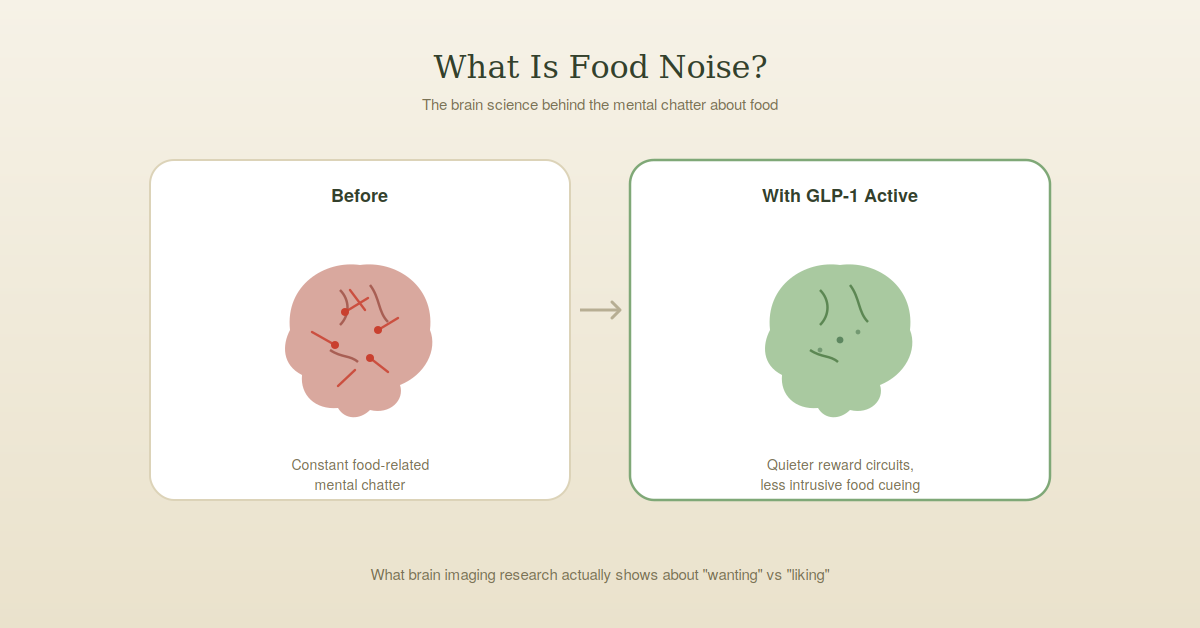
People describe it in strikingly similar terms — the constant background hum of thinking about food, planning the next meal, replaying a craving, just stops. Not the hunger exactly, but something else: an almost obsessive mental chatter about food that most people didn’t even realize was running until it suddenly wasn’t. This phenomenon has a name now — food noise — and it’s become one of the more genuinely interesting areas of obesity neuroscience in the past two years, well beyond the GLP-1 drugs that brought it into the spotlight.
[H2 BLOCK]
What Food Noise Actually Is
Food noise refers to persistent, intrusive thoughts about food that go beyond ordinary hunger — repetitive mental preoccupation with food that can show up even when someone is physically full. Researchers studying this distinguish it clearly from hunger itself: hunger is a physiological signal, driven by the hormone ghrelin, low blood glucose, and an empty stomach. Food noise is cognitive rather than physiological. It’s the difference between your body needing fuel and your mind simply not letting a thought about food go.
This isn’t a fringe or made-up concept. A formal Food Noise Questionnaire was developed and validated by researchers in 2025 specifically to measure it, and a broader research definition published the same year described food noise as a distinct, measurable construct worth studying in its own right, separate from general appetite or willpower. One study estimated that around 42% of adults experience some degree of food-related intrusive thoughts, with 15 to 20% meeting a threshold for persistent, more disruptive food noise.
The Brain Science Behind the “Wanting” vs “Liking” of Food
To understand why GLP-1 drugs affect food noise specifically, it helps to know that neuroscientists have long separated food motivation into two different systems, and they don’t always move together.
“Wanting” refers to the motivational drive to seek out and consume food — the pull that gets you up off the couch to find a snack. “Liking” refers to the actual hedonic pleasure experienced once you’re eating it. These are governed by overlapping but distinct brain circuitry, primarily involving dopamine signaling in reward regions including the nucleus accumbens, the amygdala, and the orbitofrontal cortex.
A particularly important 2025 study published in Science identified a specific group of dopamine neurons in the brain’s reward system that become active specifically during hedonic eating — eating driven by palatability rather than physical need — and that this activity directly works against the appetite-reducing effect of GLP-1 medications like semaglutide. In other words, researchers found an actual neural tug-of-war: GLP-1 signaling pushes toward satiety, while this specific dopamine pathway pushes back toward continued eating for pleasure. This helps explain, at a mechanistic level, why some people feel intensely drawn to keep eating appealing food well past the point of physical fullness — and why a medication that quiets that pull can feel like flipping a switch.
WWhat Is GLP-1 and Why Do Doctors Say It Is the Key to Weight Loss
What Brain Imaging Studies Actually Show
This isn’t just theoretical — researchers have directly observed it using brain scans, and the findings are some of the more compelling neuroimaging research in this entire field.
In studies using an earlier GLP-1 medication, researchers showed participants images of palatable food while scanning their brain activity. Compared to a placebo, the medication significantly reduced activation in the insula, amygdala, putamen, and orbitofrontal cortex — brain regions specifically associated with food cue reactivity and the desire to eat. Notably, this effect was specific to participants with obesity and wasn’t observed in lean control participants, suggesting the medication is correcting something specifically dysregulated in that group rather than uniformly suppressing reward processing in everyone.
A broader systematic review of available fMRI studies on GLP-1 receptor agonists, published in early 2026, found a consistent pattern across the accumulated research: reduced activation in reward-related brain regions in response to food cues, across multiple different GLP-1 medications and study designs. A separate 2025 imaging study specifically found that semaglutide reduced the dopamine-driven “wanting” response to food while appearing to leave hedonic “liking” comparatively more intact — supporting the idea that these medications are recalibrating the drive to seek out food, rather than simply making food taste or feel less pleasurable once it’s actually being eaten.
Healthy Foods That Spike Blood Sugar — You Won’t Expect These
The Default Mode Network Connection
One of the more recent and conceptually interesting threads in this research connects food noise to the default mode network — the same brain system responsible for mind-wandering and background mental activity during idle, unfocused moments.
A 2025 study looked at what happens after gastric bypass surgery, a procedure that naturally elevates the body’s own GLP-1 levels. When researchers pharmacologically blocked GLP-1 receptors in these post-surgery patients, default mode network connectivity increased. When GLP-1 was allowed to act normally, the network was quieter. This provides a genuine biological mechanism for what people describe anecdotally as “mental quiet” — GLP-1 isn’t only reducing hunger signals originating from the gut, it appears to also be dampening the brain’s tendency to generate food-related thoughts specifically during unfocused, idle moments, which lines up closely with how people describe food noise actually showing up in daily life: not at mealtimes, but in the in-between moments.
A 2026 narrative review went further conceptually, describing food noise as a form of “maladaptive prospection” — a repetitive, cue-driven mental simulation of short-term food reward that comes at the expense of longer-term goals, rather than simply a craving in the moment. Framed this way, food noise looks less like a willpower problem and more like a specific pattern of intrusive future-oriented thinking that happens to be focused on food.
What Happens When the Medication Stops
This is a detail worth knowing honestly, because it has real practical implications.
Food noise reliably returns within days to weeks of stopping GLP-1 treatment, which is consistent with the pharmacological nature of the effect rather than a permanent rewiring. A detailed 2025 case report using deep brain stimulation monitoring in a patient with severe obesity and binge eating disorder found that GLP-1’s suppressive effect on food-related brain activity was present during treatment but diminished over time, with one specific effect on the nucleus accumbens wearing off after approximately five months despite continued treatment — suggesting the brain may partially adapt to the medication’s effect on reward circuitry even while still taking it.
This reinforces a point that researchers in this space have made directly: GLP-1 medications appear to be managing food noise pharmacologically rather than resolving the underlying reward-circuit pattern permanently, which is part of the broader case for thinking about GLP-1 therapy, when used, as an ongoing treatment rather than a short-term fix.
How Much Protein Per Meal for Weight Loss After 40
Can You Quiet Food Noise Without Medication
This is genuinely the most actively developing area of this research, and a 2026 narrative review specifically explored mindfulness-based approaches as a complementary or alternative angle.
The reasoning connects back to the default mode network finding above: if food noise is partly a pattern of repetitive, intrusive mental simulation that occurs during idle, unfocused mental states, then interventions that specifically train attention and interrupt automatic mental looping have a plausible, if still emerging, rationale for helping. Mindfulness-based eating interventions, which train people to notice and observe food-related thoughts and urges without automatically acting on them, have shown some evidence of reducing food cue reactivity and improving eating-related self-control, through mechanisms that researchers suggest may overlap meaningfully with how GLP-1 medications affect the same reward and default-mode circuitry, even though the tools themselves work completely differently.
It’s worth being honest that this specific comparison, mindfulness training against GLP-1 medication for food noise specifically, is still a new and emerging area of research rather than something with the same depth of clinical trial evidence behind it yet. The conceptual case is genuinely interesting and grounded in real neuroscience, but it hasn’t been tested head-to-head against medication in the way GLP-1 drugs themselves have been tested against placebo.
Why This Matters Beyond Weight Loss
The food noise research has a broader implication worth sitting with: it offers a more precise, less judgmental explanation for something that’s long been mischaracterized as a simple lack of discipline.
If persistent, intrusive food-related thoughts are a measurable, brain-circuit-level phenomenon, distinct from hunger, and disproportionately present in people with obesity specifically, as the brain imaging research suggests, then struggling with constant food preoccupation isn’t a character flaw or a failure of motivation. It’s a specific pattern of reward-circuit activity that some brains generate more intensely than others, for identifiable neurological reasons that researchers are only now mapping out in real detail.
The Bottom Line
Food noise has gone from an informal phrase people used to describe a frustrating personal experience to a measurable, study-able neuroscience concept in the space of just a couple of years, with a validated questionnaire, brain imaging evidence, and a plausible mechanistic explanation now behind it. GLP-1 medications appear to quiet it by recalibrating dopamine-driven “wanting” circuits and reducing default mode network activity tied to food-related mental simulation, rather than simply suppressing hunger at the level of the stomach.
The honest caveat is that this effect appears to be actively pharmacological rather than a permanent rewiring, with food noise returning once medication stops and some evidence that its intensity may shift even during continued treatment. Whether mindfulness-based or other non-pharmacological approaches can meaningfully replicate part of this effect is a genuinely promising but still early area of research, worth watching rather than treating as settled.
Frequently Asked Questions
Is food noise the same as being hungry?
No. Hunger is a physiological signal driven by hormones like ghrelin and an empty stomach. Food noise is cognitive — persistent, intrusive thoughts about food that can show up even when you’re physically full, which is part of why researchers study it as a separate phenomenon from hunger itself.
Do only people taking GLP-1 medications experience food noise?
No, food noise exists independently of any medication. Research estimates around 42% of adults experience some food-related intrusive thoughts, with 15 to 20% meeting the threshold for more persistent food noise. GLP-1 medications didn’t create this phenomenon — they simply made many people consciously notice it for the first time by quieting it.
Does food noise come back if you stop taking GLP-1 medication?
Yes, typically within days to weeks of stopping treatment, which is consistent with the effect being pharmacological rather than a permanent change to the brain’s reward circuitry.
Can therapy or mindfulness actually reduce food noise without medication?
Early research suggests it’s possible, since food noise appears linked to default mode network activity that mindfulness training is specifically designed to influence. However, this is still an emerging research area without the same depth of clinical evidence behind it that GLP-1 medications have.
Why do some people seem to have constant food noise while others don’t think about food much at all?
Brain imaging research has found that food-cue reactivity in reward regions like the amygdala and orbitofrontal cortex is notably stronger in people with obesity compared to lean individuals, suggesting real, measurable differences in how intensely different brains generate food-related reward signals — not simply a difference in willpower or interest in food.
This article is for informational purposes only and does not constitute medical advice. If you’re experiencing persistent, distressing food-related thoughts, particularly alongside binge eating or disordered eating patterns, please speak with a healthcare professional.