
Most people assume the placebo effect only works if you don’t know you’re taking a fake pill. The whole idea seems to depend on belief, and belief seems to depend on being fooled.
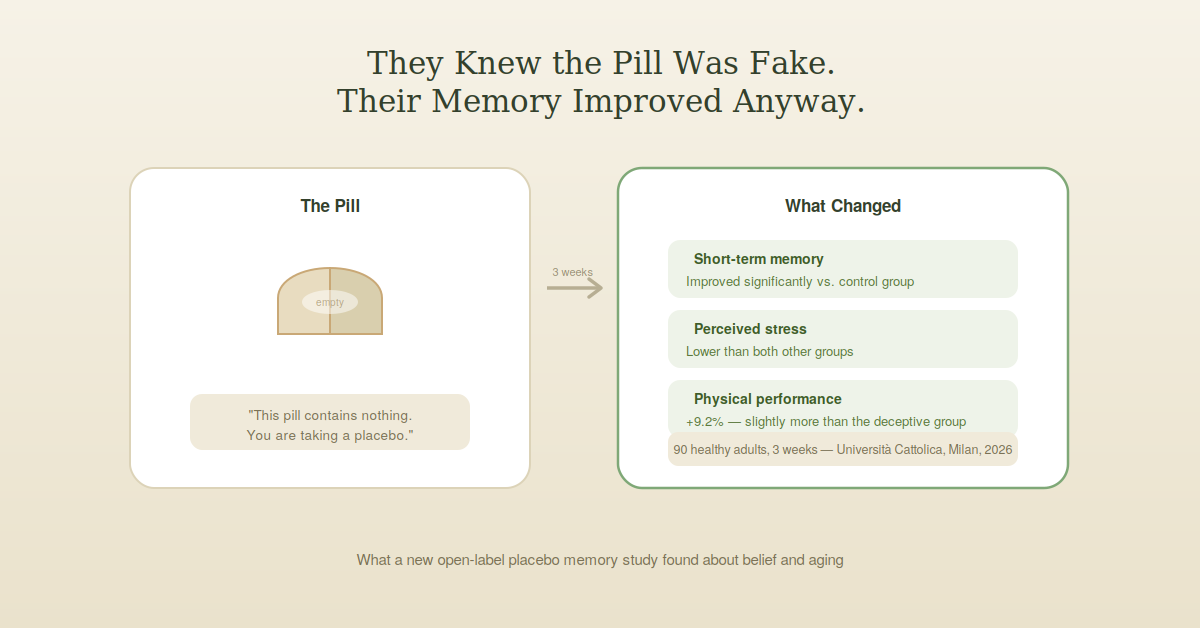
A new open-label placebo memory study has just complicated that assumption in a genuinely interesting way. Researchers in Italy gave older adults pills that contained nothing — and told them so, directly and honestly. Three weeks later, memory, physical performance, and stress levels had measurably improved anyway.
Here’s what the study actually did, what it found, and what it might mean for how we think about aging, expectation, and the mind’s influence over the body.
What This Study Actually Tested
The research came from psychologists at Università Cattolica in Milan, led by Diletta Barbiani, Alessandro Antonietti, and Francesco Pagnini, and was published in the International Journal of Clinical and Health Psychology.
Ninety healthy older adults were randomly split into three groups for three weeks. One group received no intervention at all, serving as a baseline control.
A second group received a deceptive placebo — an inert pill they were told contained active ingredients that would improve their well-being and functioning. This is the classic, traditional placebo setup most people are familiar with.
The third group received an open-label placebo. They were told plainly that the pills were inert, containing no active ingredients, but that placebos themselves are capable of producing real psychological and physical benefits through the mind-body connection.
Before and after the three weeks, all participants completed tests measuring short-term memory, selective attention, and physical performance, along with self-reported measures of stress, well-being, fatigue, optimism, and sleepiness.
Why This Question Hadn’t Really Been Asked Before
Placebo research isn’t new. What made this particular open-label placebo memory study distinct is the specific population and outcome it focused on.
Open-label placebos, where people knowingly take an inert treatment, have been studied before for things like pain and fatigue. There’s even prior research specifically on open-label placebos easing pain in older adults with knee osteoarthritis.
But no earlier study had examined whether an open-label placebo could influence the kinds of functions that naturally decline with age more broadly — memory, attention, and physical performance — rather than a specific pain condition. That gap is exactly what this research was designed to address.
What the Results Actually Showed
After three weeks, the open-label placebo group reported lower perceived stress than both the deceptive placebo group and the no-intervention control group.
Short-term memory performance improved significantly in the open-label placebo group compared with the control group. This is the headline finding, and it’s worth sitting with: people who knew, with certainty, that they were taking a fake pill still performed better on objective memory tests afterward.
Physical performance improved in both placebo groups, though by different amounts. The deceptive placebo group improved by about 7%. The open-label placebo group improved by about 9.2%, slightly outperforming the group that had been told the pill was real.
Cognitive performance improvements varied depending on which specific test was used, ranging from roughly 12.6% to 14.6% in the deceptive placebo group, and from roughly 6.9% to 21.5% in the open-label group. Despite the wider range in the open-label group’s results, the researchers noted the overall effects were comparable in size to what’s seen in some experimental studies specifically testing physical activity interventions.
Why Researchers Think This Happened
The honest answer is that the exact mechanism isn’t fully settled, but the study’s framing points to a few plausible explanations rooted in expectation and self-perception rather than any pharmacological effect, since the pills contained nothing.
Being told that a treatment “can elicit beneficial mind-body responses” appears to function as a kind of permission structure — an invitation to expect improvement, pay closer attention to your own functioning, and engage somewhat differently with daily activities during the study period.
This connects to a broader concept researchers call aging stereotypes, the often-unconscious beliefs people hold about what aging is supposed to feel like and how much decline is expected. The study specifically measured this at baseline, suggesting the researchers suspected self-perception and expectation around aging itself might be part of what’s modifiable here, separate from any belief in a specific pill’s contents.
What This Doesn’t Mean
A finding this interesting tends to get oversimplified quickly online, so a few honest limits are worth stating clearly.
This was a small study. Ninety participants split across three groups is enough to detect a real statistical effect, which the researchers did, but it’s not the kind of large sample that settles a question definitively on its own.
It was also short. Three weeks shows a real, measured effect within that window, but doesn’t tell us whether the improvement persists, fades, or grows with continued use over months or years.
This is not a treatment for any diagnosed cognitive condition. The study specifically recruited healthy older adults without dementia or diagnosed cognitive impairment, so these findings say nothing about whether open-label placebos would help, or wouldn’t help, someone with an actual neurological condition affecting memory.
And critically, this isn’t an argument for self-administering “fake pills” at home in place of real medical care or lifestyle changes with established evidence behind them, like exercise, sleep, and social engagement. The study’s own authors compared the effect size to physical activity research, not as a replacement for it, but as an interesting parallel.
Why This Finding Still Matters
Even with those limits, this open-label placebo memory study points toward something genuinely useful: ethical use of expectation and belief as a legitimate tool in supporting healthy aging, without requiring deception.
Traditional placebo treatment has always carried an ethical problem in real clinical practice — it generally requires lying to a patient about what they’re receiving, which most doctors are understandably unwilling to do outside of a research setting. If open-label placebos can produce a meaningful fraction of that same benefit while being completely honest with patients about what they’re taking, that’s a much easier thing to imagine actually being used responsibly in real care settings.
It also adds to a small but growing body of research, including earlier studies on open-label placebos for pain, fatigue, and conditions like irritable bowel syndrome, suggesting that mind-body expectation effects are more robust and more ethically usable than the “you have to be fooled for it to work” assumption most people carry.
[H2 BLOCK]
The Bottom Line
This study found that older adults who were told, honestly and directly, that they were taking a placebo still experienced measurable improvements in memory, stress, and physical performance after three weeks, with effects in some measures slightly outperforming the group that believed they were taking something real.
The research is early, small, and focused on healthy adults rather than anyone with a diagnosed condition, so it’s not a basis for any specific health decision on its own. What it does offer is a genuinely interesting data point in a growing research area: that belief, attention, and expectation can meaningfully influence how the aging body and mind perform, even without any deception involved at all.
Frequently Asked Questions
How can a placebo work if you know it’s fake?
Researchers believe the benefit comes from expectation, attention, and belief in the mind-body connection itself rather than belief in the pill’s contents. Being told that placebos can produce real psychological and physical benefits through the mind-body connection appears to be enough to activate some of those effects, even with full transparency about the pill being inert.
How big was the memory improvement in this study?
Short-term memory improved significantly in the open-label placebo group compared to the no-intervention control group. Physical performance improved by approximately 9.2%, slightly outperforming the group who believed they were taking a real supplement at around 7%.
Does this mean older adults should start taking fake pills at home?
No. The study was conducted in a specific research context with professional framing and explanation of how open-label placebos work. It doesn’t suggest self-administering inert supplements at home as a memory strategy, and shouldn’t replace evidence-based approaches like exercise, sleep, and social engagement for supporting brain health.
Could this help people with dementia or diagnosed cognitive impairment?
The study only included healthy older adults without any diagnosed cognitive condition, so it says nothing about whether open-label placebos would help, or not help, people with dementia, Alzheimer’s, or any diagnosed neurological condition. That would require separate research.
Has open-label placebo research been done before?
Yes, earlier studies have tested open-label placebos for pain, fatigue, and conditions like irritable bowel syndrome, with some positive results. What made this study new was its focus specifically on memory, attention, and physical performance in healthy older adults — areas tied to normal aging rather than a specific diagnosed condition.
This article is for informational purposes only and does not constitute medical advice. This study does not suggest that placebo treatments should replace evidence-based medical care, prescribed medication, or treatment for any diagnosed condition. Please consult a healthcare professional regarding any memory or cognitive concerns.