
Most vitamin deficiencies don’t announce themselves clearly. They show up as being a bit more tired than usual, taking longer to bounce back from a cold, or feeling vaguely “off” in a way that’s easy to blame on stress, poor sleep, or just getting older. That vagueness is part of why deficiencies are so common in the first place — the early signs rarely look like a medical problem.
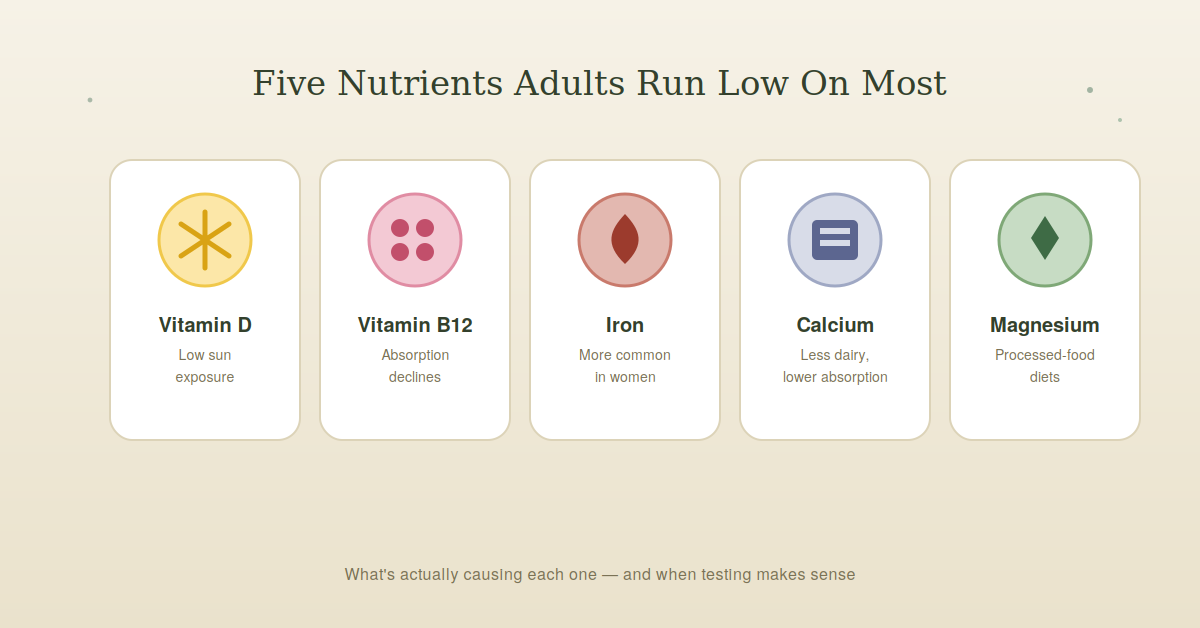
Here’s a look at the vitamins and minerals adults run low on most often, what tends to be driving each one, and what a sensible next step looks like if any of this sounds familiar.
Vitamin D — The Most Widespread Deficiency by Far
Vitamin D deficiency is consistently described as the most common nutrient deficiency among adults, with estimates suggesting that anywhere from half to nearly all adults fall short depending on location, skin tone, and time of year, since darker skin pigmentation, higher latitudes, and limited sun exposure all reduce how much vitamin D the body produces naturally.
What’s actually causing it: Vitamin D is unusual among nutrients because your body makes most of it through skin exposure to sunlight rather than getting it primarily from food. Indoor jobs, sunscreen use, living somewhere with long winters or limited sunlight, having darker skin, and simply spending most of the day inside are the main everyday drivers. Very few foods naturally contain meaningful amounts of vitamin D, so diet alone rarely closes the gap for most people. Aging adds another layer, since the skin becomes less efficient at producing vitamin D from the same amount of sun exposure later in life.
Common signs: Fatigue, bone or joint discomfort, muscle weakness, and getting sick more often than usual.
What to do: A vitamin D blood test (the 25-hydroxy-vitamin D test) is inexpensive and widely available, and it’s the only reliable way to know your actual level rather than guessing. If a doctor confirms low levels, they can recommend an appropriate dose for your specific situation — this is one of the few nutrients where appropriate dosing varies quite a bit based on how deficient someone actually is.
Vitamin B12 — Common, and Easy to Miss
Vitamin B12 deficiency affects a meaningful share of adults, and the risk rises substantially with age — some research estimates that up to 20% of adults over 60 are deficient, with many more sitting at borderline-low levels.
What’s actually causing it: B12 is found almost exclusively in animal-based foods, including meat, fish, eggs, and dairy, which makes vegetarians and vegans a clearly higher-risk group. Beyond diet, absorption is the bigger hidden issue for many people. B12 requires adequate stomach acid to be properly absorbed, and stomach acid production naturally declines with age. Certain medications add to this risk directly — proton pump inhibitors, commonly prescribed for acid reflux, and metformin, widely prescribed for type 2 diabetes, are both well-documented to reduce B12 absorption over time.
Common signs: Fatigue, weakness, lightheadedness, and in more advanced cases, tingling or numbness in the hands and feet, memory difficulties, or balance problems.
What to do: A B12 blood test can identify a deficiency, though it’s worth knowing that researchers have recently raised questions about whether the standard “normal” range fully captures everyone who could benefit from higher levels, particularly for brain health in older adults. This is a good, specific question to raise directly with a doctor, especially if you’re on a long-term medication from either category mentioned above, or follow a primarily plant-based diet.
Iron — Particularly Common in Women
Iron deficiency is strikingly widespread, with research suggesting up to 1 in 3 adults have low iron stores, even before reaching the point of full-blown anemia.
What’s actually causing it: Menstruation is one of the most significant factors, which is why iron deficiency disproportionately affects women of reproductive age. Diets low in iron-rich foods, including red meat, beans, and fortified grains, contribute as well, and plant-based iron is absorbed less efficiently by the body than the iron found in animal sources, which raises risk further for vegetarians and vegans. Frequent blood donation, pregnancy, and certain digestive conditions that affect nutrient absorption can also play a role.
Common signs: Fatigue, weakness, unusually pale skin, shortness of breath during normal activity, and feeling cold often, particularly in the hands and feet.
What to do: Iron deficiency is identified through a blood test, and it’s worth being direct about this one specifically: iron supplements are not something to start on your own without testing first. Taking iron when you don’t actually need it can cause real harm over time, since the body has a limited ability to get rid of excess iron, and unnecessarily high iron levels have been linked to organ damage with prolonged use. This is one of the clearest examples of a supplement where testing first genuinely matters, not just as a formality.
Calcium — Often Under-Consumed, Not Just Under-Discussed
Calcium gets less attention than vitamin D or B12 in general health conversations, but inadequate intake is genuinely common, particularly as people age and dairy consumption often naturally declines.
What’s actually causing it: Reduced dairy intake, whether by preference, lactose intolerance, or a plant-based diet, is the most direct driver. Calcium absorption also becomes less efficient with age, partly because it depends on adequate vitamin D and stomach acid, both of which decline over time as discussed above. This creates a kind of compounding effect, where a vitamin D shortfall can quietly worsen a calcium shortfall as well.
Common signs: Calcium deficiency is harder to notice through everyday symptoms than the nutrients above, since the body will pull calcium from bone stores to maintain normal blood levels before any obvious symptoms appear — which is precisely why long-term inadequate intake is more strongly associated with bone density loss over years than with short-term symptoms.
What to do: Rather than jumping straight to a supplement, it’s worth first looking honestly at dietary intake, since calcium is one of the nutrients where food sources, including dairy, leafy greens, and fortified plant milks, can often meaningfully close the gap. If you’re concerned about bone health specifically, a bone density scan and a conversation with a doctor about your overall calcium and vitamin D status together makes more sense than supplementing calcium in isolation.
Magnesium — Widespread and Frequently Overlooked
Magnesium deficiency doesn’t get nearly as much mainstream attention as the nutrients above, but the numbers are notable — more than 70% of adults over 70 don’t get enough daily magnesium, and shortfalls are common across younger age groups too.
What’s actually causing it: Modern diets heavy in processed foods tend to be naturally low in magnesium, since it’s concentrated in foods like leafy greens, nuts, seeds, and whole grains that make up a smaller share of many people’s actual eating patterns. Certain medications, including some diuretics prescribed for blood pressure, increase magnesium loss through urine over time. Digestive conditions that affect nutrient absorption, and high alcohol intake, can also contribute.
Common signs: Muscle cramps or twitches, fatigue, and in more pronounced deficiency, irregular heartbeat or sleep disturbances.
What to do: A standard blood magnesium test has real limitations, since most magnesium in the body is stored in bone and muscle tissue rather than circulating in blood, meaning blood levels can look normal even when overall body stores are low. This is genuinely worth discussing with a doctor if you have risk factors above, rather than relying solely on a standard blood test result to rule it out.
A Sensible Way to Approach This
If any of the causes above sound familiar — a mostly indoor lifestyle, a long-term medication from the categories mentioned, a primarily plant-based diet, or simply being in an age group where absorption naturally declines — testing is the most reliable next step, and it’s a reasonable, low-cost conversation to have at a routine check-up rather than something that requires a special appointment.
It’s worth repeating directly: supplementing based on a guess, particularly for iron, carries real risk if you’re not actually deficient, and even for the lower-risk nutrients above, a doctor can advise on the right dose and form for your specific situation, including any interactions with medications you’re already taking. A blood test is inexpensive relative to the cost of guessing wrong in either direction — taking something you don’t need, or missing a deficiency that’s quietly affecting how you feel.
The Bottom Line
Vitamin D, B12, iron, calcium, and magnesium account for the large majority of nutrient shortfalls seen in adults, and each one tends to trace back to a specific, identifiable cause — limited sun exposure, certain medications, diet patterns, age-related absorption changes, or some combination of these. None of these deficiencies are particularly mysterious once you know what to look for.
What’s genuinely useful here isn’t a list of supplements to start taking today. It’s recognizing which of these causes might apply to your own life, and treating that as a reason to ask for the right blood test rather than guessing at a solution from a supplement aisle.
This article is for informational purposes only and does not constitute medical advice. Please consult a qualified healthcare provider before starting any supplement, and seek testing to confirm an actual deficiency before treating one, particularly for iron.
[…] The Most Common Vitamin Deficiencies and What’s Actually Causing Them […]