
The energy supplement industry is worth over $57 billion, which tells you two things. One, a lot of people are tired. Two, a lot of companies are cashing in on that.
Walk into any health store and you’ll find shelves stacked with products making bold promises — “all-day energy,” “zero crash,” “feel it in 30 minutes.” Most of them are built around caffeine, a hit of B vitamins at doses the body can’t absorb, and not much else.
The supplements that actually make a difference aren’t usually the loudest ones in the room. They work slower, more quietly, and through mechanisms your body actually needs — not just a stimulant that borrows energy from tomorrow to pay for today.
Here are five that have genuine evidence behind them, what each one does, and how to take them properly.
1. Vitamin B12 — The Most Common Energy-Robbing Deficiency
If your fatigue has crept up gradually over months, and you also feel foggy, slightly off-balance, or notice your hands and feet tingling occasionally, B12 is the first place to look.
Vitamin B12 is essential for converting the food you eat into cellular energy. It’s also required for red blood cell production and proper neurological function. When levels drop, the entire energy-production process slows down — and it happens far more commonly than most people realise.
Up to 20% of adults over 40 are deficient in B12, and the figure climbs significantly after 60. The reason is usually absorption, not diet. As stomach acid production declines with age, B12 from food becomes harder to absorb even if you’re eating plenty of it. Certain medications — particularly metformin for diabetes and proton pump inhibitors for acid reflux — reduce B12 absorption directly.
Vegetarians and vegans are also at higher risk, since B12 is found almost exclusively in animal-based foods.
What to take: Methylcobalamin is the most bioavailable form. Sublingual tablets, which dissolve under the tongue, bypass the gut and absorb directly into the bloodstream — a significant advantage for anyone with absorption issues.
How long to notice a difference: If your fatigue is genuinely caused by B12 deficiency, improvements typically begin within two to four weeks of consistent supplementation.
One important note: Get your B12 level tested before supplementing heavily. A doctor can identify whether deficiency is actually the issue and at what dose supplementation makes sense for you.
2. Iron — The Leading Nutritional Cause of Fatigue in Women
Iron deficiency is the most common nutritional deficiency in the world, affecting roughly 25% of women globally. And fatigue — often a deep, heavy, difficult-to-shake exhaustion — is its most well-known symptom.
Iron is required for haemoglobin, the protein in red blood cells that carries oxygen from your lungs to every cell in your body. Without enough of it, your muscles and organs are working in a constant state of mild oxygen deprivation. The result is the kind of tiredness that sleep doesn’t fully fix.
Women of reproductive age are the highest-risk group due to monthly blood loss, but iron deficiency also affects pregnant women, frequent blood donors, vegetarians and vegans, and athletes, particularly female distance runners.
What to take: Ferrous bisglycinate is generally the gentlest and best-absorbed form. Unlike standard ferrous sulfate, it causes significantly less digestive discomfort for most people.
How to take it: Iron absorbs best on an empty stomach or with vitamin C. Avoid taking it with coffee, tea, or calcium supplements, all of which reduce absorption.
Critical warning: Iron is one supplement you should never start without testing first. Taking iron when you’re not deficient can cause real harm over time, since the body has limited ways to excrete excess iron. A simple blood test checking ferritin and serum iron levels tells you whether supplementation is actually needed.
3. CoQ10 — The Supplement Your Mitochondria Actually Use
CoQ10 is one of the more misunderstood supplements on the market — partly because it sounds technical and partly because it’s often lumped in with overpriced “anti-aging” products.
But the mechanism behind it is straightforward. CoQ10 is a compound your body produces naturally and uses directly inside the mitochondria, the parts of every cell responsible for producing energy. It sits at the heart of the process that converts oxygen and nutrients into ATP, the actual fuel cells run on.
The problem is that CoQ10 production declines with age. It’s also directly depleted by statin medications, commonly prescribed for high cholesterol — which is why fatigue and muscle weakness are frequent complaints from statin users, and why CoQ10 supplementation is often discussed alongside statin therapy.
A 2022 meta-analysis of 13 randomised controlled trials found statistically significant reductions in fatigue scores with CoQ10 supplementation versus placebo across more than 1,100 participants. That’s a meaningfully stronger evidence base than most energy supplements have.
What to take: Ubiquinol, the reduced form of CoQ10, absorbs considerably better than standard ubiquinone, particularly in older adults. This distinction matters more in practice than the brand.
How to take it: CoQ10 is fat-soluble. Take it with a meal that contains some fat for proper absorption. Doses in clinical trials range from 100 to 300mg daily.
Timeline: CoQ10 works slowly. Most people notice meaningful differences after four to eight weeks of consistent use. If you’re expecting something to feel in a week, this isn’t that kind of supplement.
4. Ashwagandha — For the Fatigue That Comes From Stress
Not all fatigue comes from a deficiency. Some of it comes from a body that’s been running on cortisol for too long — the kind of exhaustion that comes with chronic stress, long work hours, poor sleep, and that background hum of anxiety that never fully switches off.
For this specific type of fatigue, ashwagandha is one of the most consistently supported natural options available.
Ashwagandha is an adaptogen, a class of plant-derived compound that works by modulating the hypothalamic-pituitary-adrenal (HPA) axis — essentially, the system your body uses to regulate its stress response. Rather than suppressing stress entirely, ashwagandha helps the system become less reactive, which means cortisol doesn’t spike as hard or stay elevated as long.
A 2019 randomised controlled trial found that 600mg of ashwagandha extract daily significantly improved stress resilience, sleep quality, and self-reported energy levels compared to placebo. Other trials have shown reductions in cortisol of 20 to 30% with consistent use.
It’s worth being clear about what ashwagandha is and isn’t. It won’t give you a burst of energy an hour after taking it. It works gradually, over six to eight weeks, by reducing what’s draining your energy in the first place — not by stimulating more of it artificially.
What to take: Look for a standardised root extract with a guaranteed withanolide content, typically around 5%. KSM-66 is the most widely studied branded extract.
How to take it: Unlike rhodiola, which is mildly stimulating and works better in the morning, ashwagandha has a calming effect and works well taken in the evening.
Who should be cautious: Ashwagandha can cause nausea and digestive discomfort in some people. It may also interact with thyroid medication and immunosuppressants. If you’re pregnant or managing a thyroid condition, speak to a doctor before starting it.
5. Rhodiola Rosea — For Mental Fatigue and Brain Fog
If your energy problem is less “I can’t get off the sofa” and more “I can’t think clearly,” rhodiola is worth knowing about.
Rhodiola rosea is another adaptogen, but with a distinctly different character from ashwagandha. Where ashwagandha calms, rhodiola sharpens. It’s been used in traditional medicine in Russia and Scandinavia for centuries, specifically by people working in cognitively demanding conditions — military personnel, night-shift workers, people operating under sustained mental pressure.
A systematic review found that rhodiola reduces mental fatigue and supports cognitive performance under sustained stress, with the strongest evidence in acute and high-stress scenarios. It appears to work by reducing the degradation of key neurotransmitters involved in focus and mental energy, rather than by stimulating the central nervous system the way caffeine does.
It doesn’t cause the jitteriness or crash associated with stimulants because it isn’t one. The energy it supports is steadier and more cognitive than physical.
What to take: Look for a standardised extract with 3% rosavins and 1% salidroside. These are the active compounds responsible for the documented effects.
How to take it: 200 to 600mg per day, taken in the morning or early afternoon. Taking it too late in the day can mildly interfere with sleep in some people, since it has a subtle activating quality.
Timeline: Rhodiola tends to work faster than the other supplements on this list. Some people notice a difference within one to two weeks.
Which One Should You Actually Start With?
The honest answer is that it depends on what’s causing your fatigue, not which supplement sounds most appealing.
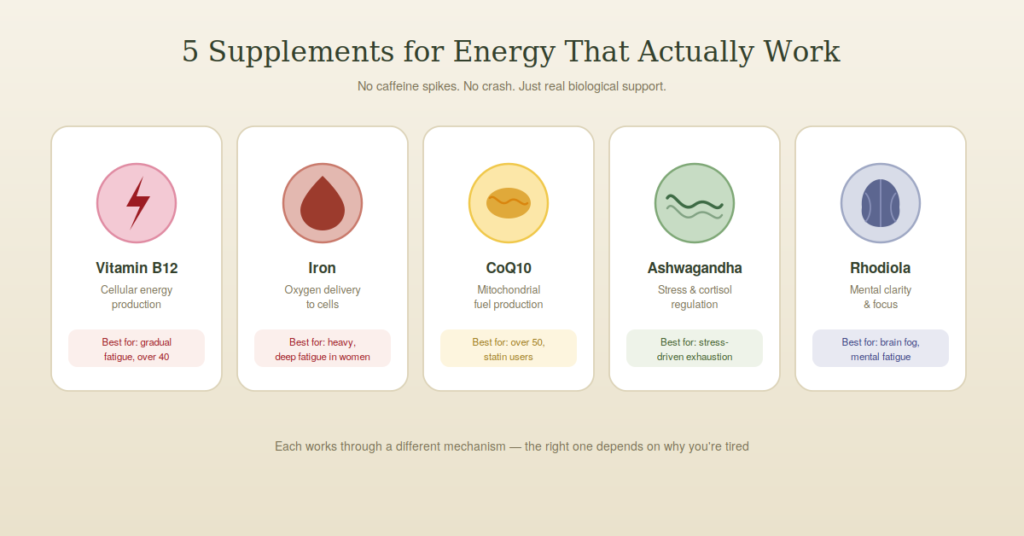
If your energy dips after gradual months of increasing tiredness and you’re over 40, over a plant-based diet, or on medication for acid reflux or diabetes — start with a B12 test.
If you’re a woman experiencing deep, heavy fatigue that sleep doesn’t fix — check your ferritin levels before anything else. A blood test takes ten minutes and could save you months of guessing.
If you feel energy as a general physical depletion and you’re on statins, or over 50 — CoQ10 is worth a proper eight-week trial.
If your fatigue is driven by stress, poor sleep, and feeling permanently overwhelmed — ashwagandha, taken consistently for six to eight weeks, addresses the root cause rather than masking it.
If your energy issue is specifically cognitive — brain fog, difficulty concentrating, mental exhaustion rather than physical — rhodiola is the most targeted option.
Starting with one supplement and giving it a proper trial period before adding another makes it considerably easier to know what’s actually working.
A Few Things Worth Knowing Before You Buy
The supplement industry is largely unregulated compared to pharmaceuticals, which means quality varies enormously between brands even when the label says the same thing.
Look for third-party tested products — certifications from NSF International, USP, or Informed Sport mean the contents have been independently verified to match what’s on the label.
Be realistic about timelines. None of the supplements above work like caffeine. The ones with the strongest evidence tend to work over weeks, not hours, because they’re addressing underlying biological causes rather than providing a temporary lift.
And if your fatigue is severe, has appeared suddenly, or is accompanied by other symptoms — unexplained weight changes, hair loss, breathlessness, persistent brain fog — get a blood panel done before spending money on supplements. Fatigue is one of the most non-specific symptoms the body produces, and some of its causes respond to medical treatment rather than supplementation.
This article is for informational purposes only and does not constitute medical advice. Always consult a qualified healthcare professional before starting any new supplement, particularly if you take prescription medication, have an underlying health condition, or are pregnant.