
You’re doing everything right. Eight hours in bed, lights off at a decent time, phone down. And yet you wake up feeling like you barely slept at all.
This is one of the most common and most frustrating health complaints there is. And the reason it goes unresolved for so long in most people is that the search for answers starts in the wrong place.
The question isn’t usually how much sleep you’re getting. It’s what’s happening during it, and what’s happening in your body the rest of the time that sleep simply can’t fix.
Here are the most common reasons you’re still exhausted after a full night — and what each one actually means for how you feel.
1. Your Sleep Is Lighter Than You Think
Eight hours in bed isn’t the same as eight hours of quality sleep.
Your body cycles through different sleep stages throughout the night, including light sleep, deep sleep, and REM sleep. Deep sleep is where physical restoration happens — tissue repair, immune function, growth hormone release. REM sleep is where memory consolidation and emotional processing occur.
If something is fragmenting your sleep — even briefly and without you fully waking up — your body keeps getting bumped back into lighter stages. You log the hours, but you miss the depth.
Alcohol is one of the most common culprits. Even one or two drinks before bed reliably suppresses REM sleep in the second half of the night, which is why people who drink in the evening often report vivid, restless sleep and feeling unrefreshed.
Stress does the same thing. Your nervous system stays in a low-level state of alert even while you’re asleep, which prevents the deep, restorative stages from fully engaging.
2. You May Have Sleep Apnea Without Knowing It
This is probably the most underdiagnosed reason for waking up tired, and it’s more common than most people realise.
Obstructive sleep apnea affects roughly 4 to 15% of the population — and the majority of people who have it haven’t been diagnosed. It happens when the airway partially collapses during sleep, causing breathing to stop and restart repeatedly throughout the night. Each time it happens, the brain briefly wakes the body up to restore normal breathing, often without the person ever fully regaining consciousness.
The result is a night of technically logged hours that was actually interrupted dozens, sometimes hundreds, of times. No wonder you wake up exhausted.
Sleep apnea also triggers cortisol spikes throughout the night. Each time breathing stops, the brain interprets it as a threat and releases a surge of stress hormone. Those overnight cortisol spikes raise blood glucose, suppress immune function, and leave you wired-but-tired the next morning.
Symptoms to watch for: loud snoring, waking with a dry mouth or headache, feeling exhausted no matter how long you sleep, or your partner noticing you stop breathing.
If any of these sound familiar, a sleep study — now available as a simple home test in many countries — is worth discussing with a doctor. This is one condition where lifestyle adjustments alone won’t solve the problem.
3. Your Cortisol Pattern Has Shifted
Cortisol has a natural rhythm. It should be low at night, rise sharply in the early morning to help you wake up, then gradually decline through the day.
When that rhythm gets disrupted — through chronic stress, irregular sleep schedules, shift work, or simply too many late nights — the pattern inverts or flattens. Cortisol stays too high at night, keeping your nervous system activated during sleep. Then it fails to spike properly in the morning, leaving you with that stuck-in-mud feeling when you try to get up.
Chronically elevated overnight cortisol is a specific pattern worth knowing about. It can cause trouble staying asleep, waking between 2am and 4am, and lying there feeling tired but somehow alert and restless. If that description sounds familiar, cortisol dysregulation is worth looking into rather than assuming you simply have insomnia.
Managing it starts with the basics — consistent sleep and wake times, morning light exposure within 30 minutes of waking, and reducing stimulation in the evening. These aren’t vague wellness suggestions. They are the specific environmental signals your cortisol rhythm relies on to reset properly.
The Most Common Vitamin Deficiencies and What’s Actually Causing Them
4. An Underactive Thyroid Is Slowing Everything Down
Your thyroid gland controls your body’s metabolic rate — essentially the speed at which every cell in your body converts nutrients into energy. When it’s underperforming, everything slows down.
Hypothyroidism, an underactive thyroid, is one of the most commonly missed causes of persistent fatigue. It develops gradually, often over years, and its symptoms are easy to attribute to other things — aging, stress, being busy, not sleeping enough.
The exhaustion it causes is distinctive. It’s the kind that doesn’t respond to sleep at all, no matter how much you get. Sleep cannot compensate for a metabolism that’s running at 60% capacity, because the problem isn’t a lack of rest. It’s that your cells aren’t generating energy efficiently in the first place.
Hypothyroidism is common — particularly in women — and straightforward to test for. A TSH test at your next routine blood draw is all it takes to rule it out. If it’s identified, it’s also highly treatable.
Other signs that warrant a thyroid check alongside persistent fatigue: unexplained weight gain, feeling cold when others aren’t, dry skin and hair, constipation, and a low mood that doesn’t quite respond to the usual things.
5. Iron Deficiency Is Limiting Your Oxygen Supply
Your red blood cells carry oxygen from your lungs to every tissue in your body. Iron is what makes that possible.
When iron levels are low — even before a full anemia diagnosis — that oxygen delivery becomes less efficient. Your muscles and organs are working in a state of mild, constant oxygen deprivation. The result is a heavy, unshakeable fatigue that sleep genuinely cannot fix, because the problem is happening at a cellular level, not at the level of how many hours you spent in bed.
Iron deficiency is the most common nutritional deficiency worldwide. It’s especially prevalent in women of reproductive age, pregnant women, vegetarians and vegans, and frequent blood donors.
The key lab value to check isn’t just haemoglobin. Ferritin — the stored form of iron — can be significantly depleted while haemoglobin still looks normal. Many people are told their “iron is fine” based on haemoglobin alone, while their ferritin sits at a level too low to sustain proper energy production.
If you’re a woman who is always tired, a full iron panel including ferritin is one of the highest-yield tests you can ask for.
10 Signs Your Thyroid Is Underactive — Most People Miss These
6. Blood Sugar Swings Are Draining Your Energy
A diet heavy in refined carbohydrates and sugar creates a cycle of sharp glucose spikes followed by rapid drops. Each drop triggers a stress response — cortisol and adrenaline are released to pull glucose back up — and that hormonal rollercoaster is exhausting.
The overnight version of this is particularly relevant to morning fatigue. If blood sugar drops during the night, the body releases cortisol and adrenaline to correct it. Those hormones wake you up, or at least bring you into lighter sleep, at 3am or 4am.
You might go back to sleep. But the quality of sleep after that point is often light and unrefreshing.
Prediabetes and early type 2 diabetes frequently present as persistent fatigue before any other symptoms become obvious. Blood glucose that’s elevated but not yet in the diabetic range still disrupts energy metabolism in a measurable way.
A fasting glucose test or HbA1c at your annual check-up can pick this up easily. If your diet includes a lot of refined carbohydrates or sugar, stabilising your blood sugar through more protein, fibre, and healthy fat at each meal is one of the most underappreciated changes you can make for sustained energy.
7. Your Sleep Timing Is Fighting Your Biology
Timing matters as much as duration. Your body has an internal clock — a circadian rhythm — that determines when you’re biologically primed to sleep and when you’re primed to be awake. When your actual sleep schedule aligns with that biological timing, sleep is deep and restorative. When it doesn’t, you can log plenty of hours and still feel like you slept badly.
This is why shift workers, people who sleep very differently on weekdays versus weekends, and people who are natural night owls but wake at 6am for work often feel permanently underslept despite adequate total hours.
The light environment around your sleep matters too. Exposure to bright or blue-toned light in the two hours before bed suppresses melatonin production and shifts your body clock later, making it harder to enter deep sleep early enough in the night when the most restorative slow-wave sleep tends to occur.
Consistent sleep and wake times — even on weekends — are the single most effective way to stabilise circadian timing. Morning light exposure within 30 minutes of waking tells your body clock where it is in the day and sets the countdown for when melatonin should rise that evening.
The 5 Best Supplements for Energy That Actually Work
When to See a Doctor
Persistent fatigue despite adequate sleep is not something to normalise as “just stress” or “getting older” — particularly when it’s been going on for more than a few weeks.
A basic blood panel can rule out several of the causes above in a single appointment. The tests worth asking about include TSH for thyroid function, a full iron panel including ferritin, vitamin B12, vitamin D, fasting glucose or HbA1c, and a full blood count.
If snoring, morning headaches, or witnessed breathing pauses are part of the picture, mention this specifically — sleep apnea is frequently missed because patients don’t bring it up and doctors don’t always ask.
Fatigue that comes with mood changes, unexplained weight changes, chest tightness, or breathlessness on minimal exertion deserves prompt attention rather than a wait-and-see approach.
The Bottom Line
Waking up tired after eight hours of sleep isn’t normal, and it isn’t inevitable.
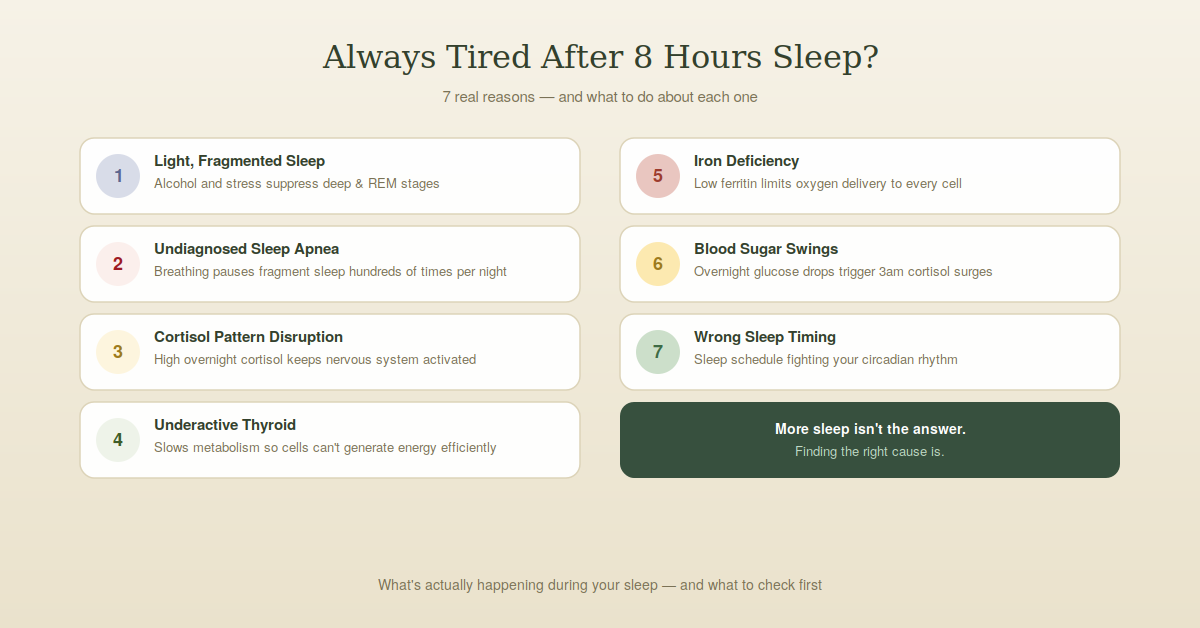
The cause is almost always one of a handful of identifiable, treatable things — fragmented sleep architecture, sleep apnea, cortisol dysregulation, an underactive thyroid, iron deficiency, blood sugar instability, or a sleep schedule fighting your biology.
None of these are fixed by sleeping more. Each one has a specific answer, and finding that answer starts with paying attention to the right signals rather than just counting hours.
This article is for informational purposes only and does not constitute medical advice. If you have persistent fatigue that is affecting your daily life, please consult a qualified healthcare professional. Some causes of fatigue described in this article require medical diagnosis and treatment.