
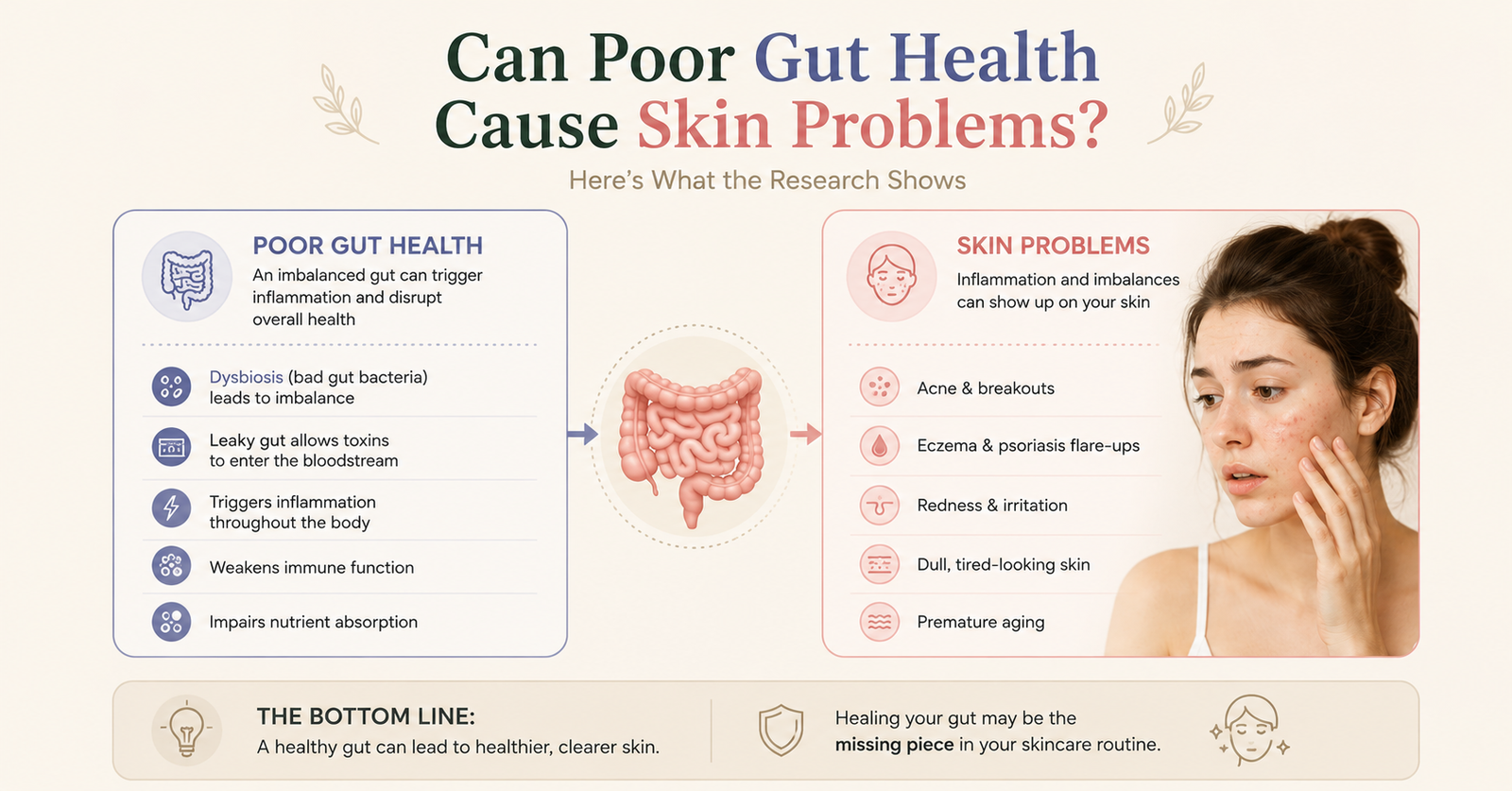
Can poor gut health cause skin problems? Growing research suggests the answer may be yes. If you’ve ever broken out during a stressful week, noticed your eczema flare after a course of antibiotics, or seen someone’s rosacea improve after making changes to their diet, you’ve already witnessed the connection between the gut and the skin. Scientists have spent years studying what’s known as the gut-skin axis—the constant two-way communication between your digestive system and your skin. While gut health isn’t the only factor behind skin conditions, maintaining a healthy gut may play an important role in supporting clearer, healthier-looking skin.
This idea has a name in dermatology and gastroenterology research now: the gut-skin axis. It’s no longer a fringe wellness theory. It’s an active, fast-growing area of peer-reviewed research, with new studies on the mechanism published just about every month through 2025 and into 2026. Here’s what’s actually been established, what’s still being worked out, and what it might mean for your own skin.
What the Gut-Skin Axis Actually Means
The term describes a bidirectional relationship between your gastrointestinal system and your skin — meaning each one can influence the other, not just one feeding into the other in a single direction. Researchers studying this describe it as a complex interaction driven by immune modulation, systemic inflammation, and the dynamics of your gut microbiota.
To understand why this connection exists at all, it helps to know that your gut and your skin have more in common biologically than you’d expect. Both are barrier organs — surfaces whose job is to separate the inside of your body from the outside world while still allowing useful exchange to happen. Both host enormous, dedicated microbial communities: your gut is estimated to contain around 100 trillion microbial cells, while your skin hosts roughly 1 trillion of its own. And both are deeply wired into your immune system, since a huge proportion of your body’s immune activity is coordinated from your gut lining.
When the balance of bacteria in your gut shifts in an unhealthy direction, a state researchers call dysbiosis, it doesn’t stay contained to your digestive system. Dysbiosis can mean a loss of beneficial bacterial species, an overgrowth of harmful ones, or simply a drop in overall microbial diversity — and any of these shifts can trigger immune and inflammatory signals that travel well beyond the gut itself, with skin being one of the most visible places those signals show up.
The Research Connecting Gut Health to Specific Skin Conditions
This isn’t a vague, one-size-fits-all claim that “bad gut health causes bad skin.” Researchers have been examining specific skin conditions individually, and the evidence varies somewhat by condition.
Acne has one of the more developed research trails. Reviews describe a “gut-brain-skin axis” specifically for acne, where gut microbial imbalance is thought to interact with stress hormones and inflammatory pathways that influence the skin’s oil production and the bacterial environment on the skin’s surface where acne develops. Several randomized controlled trials have tested probiotics, particularly Lactobacillus strains, alongside diets higher in omega-3 fatty acids and fiber, with some trials showing a beneficial effect on acne severity — though researchers reviewing this evidence base are careful to note that consistent, large-scale human data is still somewhat limited.
Atopic dermatitis (eczema) has perhaps the strongest clinical trial evidence of any skin condition in this research area. A comprehensive late-2025 review of pediatric randomized controlled trials found that multi-strain probiotic formulations, generally dominated by Lactobacillus combined with Bifidobacterium, produced modest but measurable improvements in eczema severity and itching, along with improvements in certain skin barrier and inflammation markers.
Psoriasis and rosacea show some of the most interesting recent evidence specifically because researchers have moved beyond simple correlation. Mendelian randomization studies, a research method that uses genetic data to help establish whether a relationship is likely causal rather than coincidental, have found causal links between specific gut bacterial species and the risk of developing eczema, acne, psoriasis, and rosacea. One specific bacterial species, Eubacterium fissicatena, has been linked through this method to psoriasis risk specifically.
This matters because most earlier gut-skin research could only show that two things were correlated — people with skin condition X tended to also have gut profile Y — without being able to say confidently which one was actually causing the other, or whether something else entirely was driving both. Mendelian randomization studies get considerably closer to demonstrating actual causation, which is a meaningful step up in evidence quality.
Read more Is TikTok’s Gut Healing Diet Actually Healthy? What Nutrition Experts Want You to Know
How a Gut Problem Actually Becomes a Skin Problem
The biological pathway connecting the two isn’t fully mapped yet, but researchers have identified several plausible mechanisms that likely work together rather than any single explanation acting alone.
Intestinal permeability is one of the most discussed mechanisms. Your gut lining is designed to let nutrients through while keeping larger, potentially inflammatory particles contained. When that lining becomes more permeable than it should be, sometimes referred to informally as “leaky gut,” bacterial fragments and inflammatory compounds can pass into the bloodstream more easily than normal. This can trigger a broader immune and inflammatory response that isn’t confined to the digestive system, and skin inflammation is one of the more visible downstream effects researchers have linked to this process.
Systemic inflammation is the throughline connecting almost every condition studied in this research area. Gut dysbiosis is associated with elevated inflammatory signaling throughout the body. Since several common skin conditions, including acne, eczema, psoriasis, and rosacea, are fundamentally inflammatory conditions at the skin level, a gut environment that’s pushing your baseline inflammation higher provides a plausible amplifying effect on whatever is already happening in your skin.
Microbial metabolites are a more specific and increasingly studied piece of the puzzle. Beneficial gut bacteria produce compounds, including short-chain fatty acids, as a byproduct of fermenting fiber. These metabolites circulate through the body and appear to have direct effects on immune regulation and inflammation control, including in skin tissue. A gut environment lacking the bacterial diversity to produce these compounds in sufficient amounts may be missing an important anti-inflammatory input that skin health depends on.
The relationship runs both ways. This is a detail that’s easy to miss but genuinely interesting — research has found that skin injury itself can directly remodel the composition of the gut microbiome, not just the other way around. The gut-skin axis isn’t simply gut problems causing skin problems downstream. It’s closer to two connected systems constantly influencing each other in both directions.
Read more What Is Akkermansia and Why Gut Health Experts Are Suddenly Obsessing Over It
What This Doesn’t Mean
Given how compelling this research area is, it’s worth being clear about its limits, because gut-health framing has become a popular marketing angle for skincare and supplement products that overstate what’s actually established.
This research does not mean every case of acne, eczema, or rosacea is caused by gut health, or that fixing your gut will resolve a skin condition on its own. Skin conditions are influenced by genetics, hormones, skin barrier function, the skin’s own separate microbiome, environmental triggers, and in many cases, factors that have nothing to do with gut health at all. The gut-skin axis represents one contributing factor among several, with its relative importance likely varying considerably from person to person and condition to condition.
The probiotic trial evidence, while genuinely encouraging, particularly for eczema, is also still generally described by the researchers conducting it as showing “modest” improvements, not dramatic resolution. And reviewers studying acne specifically have noted directly that there remains a shortage of large, consistent human studies, despite promising early results — an honest acknowledgment that the field is still maturing.
What You Can Reasonably Do With This Information
Given the current state of the research, a few practical, low-risk approaches are reasonably well supported.
Supporting gut microbial diversity through diet is the most broadly evidence-aligned starting point, since diverse, fiber-rich diets are consistently associated with the kind of beneficial bacterial metabolite production discussed above. This generally means a diet with a wide variety of fiber sources, fermented foods, and minimally processed ingredients, rather than any single “gut-skin superfood.”
Considering a probiotic, particularly for diagnosed eczema, has the most direct clinical trial support of any specific gut-skin intervention discussed here, with multi-strain Lactobacillus and Bifidobacterium formulations showing the most consistent results in pediatric trials specifically. Speaking with a dermatologist or pediatrician about strain-specific options is reasonable if this is relevant to you or a family member.
Being cautious of products making sweeping gut-skin claims is worth keeping in mind, given how new and still-developing much of this specific research is. A product referencing “the gut-skin axis” on its packaging isn’t automatically backed by the level of evidence this article has described — the legitimate research applies to specific bacterial strains, specific conditions, and generally modest effect sizes, not a universal mechanism that any product can claim to address.
Not abandoning standard dermatological treatment in favor of gut-only approaches is an important caution. Even researchers most enthusiastic about this research area describe gut-microbiome-targeted therapies as promising adjuncts, additions alongside standard treatment, rather than replacements for it.
The Bottom Line
The gut-skin axis has moved from an interesting theory to a genuinely active, well-funded area of medical research, with 2025 alone producing multiple substantial reviews and, notably, causal evidence from Mendelian randomization studies connecting specific gut bacteria to specific skin conditions. This is meaningfully stronger evidence than existed just a few years ago.
What it doesn’t yet support is the idea that gut health is the primary driver of any given skin condition, or that gut-focused interventions alone will resolve a stubborn skin issue. The most honest current summary: your gut and your skin are demonstrably in communication with each other, dysbiosis appears to be a genuine contributing factor to several common skin conditions, and supporting gut diversity through diet is a reasonable, low-risk piece of an overall approach to skin health — alongside standard dermatological care, not instead of it.
This article is for informational purposes only and does not constitute medical advice. If you have a persistent or severe skin condition, please consult a dermatologist for proper diagnosis and treatment.
[…] Can Poor Gut Health Cause Skin Problems? Here’s What the Research Shows […]