
Most joint problems don’t arrive suddenly. They creep up quietly, one small change at a time, until one day you notice that things you used to do without thinking — climbing stairs, getting up from a chair, opening a jar — have started to require a little more effort or a little more pain than they should.
The warning signs your joints are getting worse are easy to dismiss, especially early on. A bit of stiffness that wears off. A click that sounds alarming but doesn’t hurt. Some swelling after a long day on your feet. Most people shrug these off as normal aging and get on with things.
Some of it is normal aging. But some of it is your joints telling you something is changing — and that earlier attention to what’s happening inside the joint gives you considerably more options than waiting until the damage is advanced.
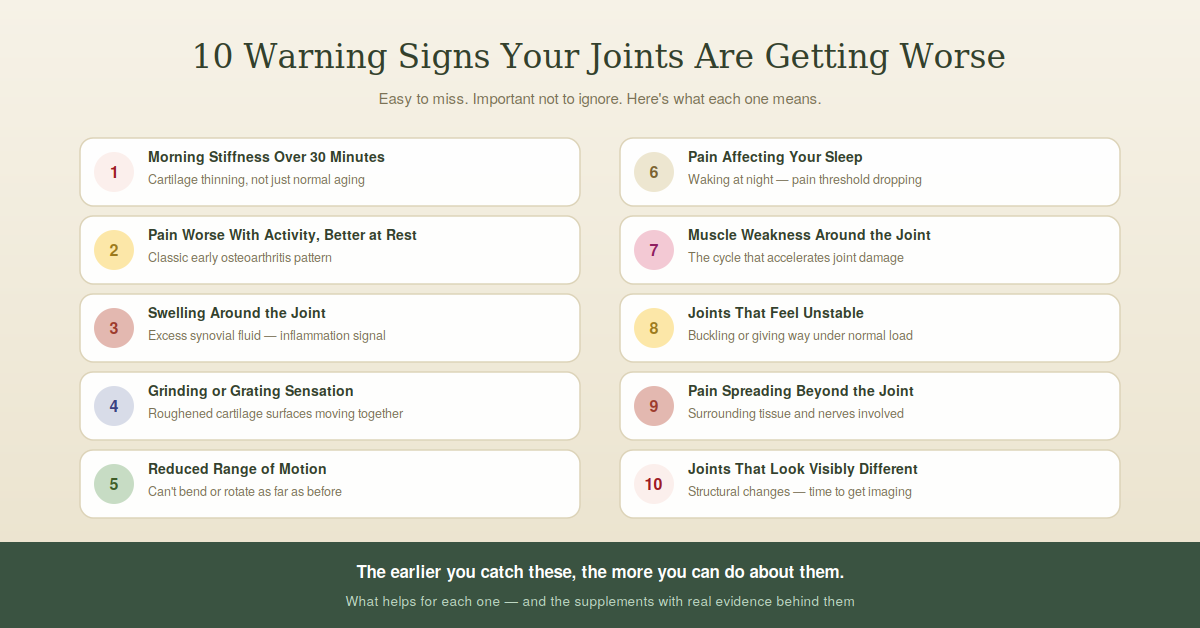
Here are ten of the most important signals to pay attention to, what each one usually means, and what actually helps.
1. Morning Stiffness That Takes More Than 30 Minutes to Clear
Almost everyone feels a little stiff when they first get up in the morning. That’s normal — joints that haven’t moved for seven or eight hours need a moment to get going.
What’s not normal is stiffness that lasts 30 minutes, 45 minutes, or longer before it begins to ease. Prolonged morning stiffness is one of the clearest early signals that something is changing inside the joint.
In osteoarthritis, the most common joint condition, this happens because the cartilage cushioning the joint has thinned and the joint fluid has become less effective at lubricating movement overnight. In inflammatory arthritis, like rheumatoid arthritis, prolonged morning stiffness — often lasting an hour or more — is a key diagnostic feature.
The stiffness itself isn’t the problem. It’s what it’s telling you about what’s happening inside.
What helps: Gentle movement as soon as you wake up — not vigorous exercise, but slow, deliberate movement through the joint’s range of motion. This stimulates synovial fluid production, which lubricates the joint, and gradually eases the stiffness. A warm shower first thing also helps by increasing circulation and warming the joint.
2. Pain That Gets Worse With Activity and Better With Rest
Early osteoarthritis pain typically follows a specific pattern: it builds during activity and eases when you rest. This is different from inflammatory joint conditions, where pain is often worse after rest and improves with movement.
This activity-related pain pattern is your joint telling you that the cartilage cushioning it is no longer doing its job as well as it should. The friction of movement on a thinned or roughened cartilage surface produces pain. When you rest, the pressure is removed and the pain settles.
The concern is that this pattern tends to progress if nothing changes. Pain that once came only after a long walk begins to come during shorter walks. Then after climbing stairs. Eventually it can be present even at rest.
What helps: Staying active but in lower-impact ways — swimming, cycling, and walking on flat surfaces put less stress on joints than running or high-impact exercise. Maintaining a healthy weight removes a significant load from weight-bearing joints. Targeted strengthening of the muscles around affected joints — particularly the quadriceps for knee pain — distributes the load more effectively and reduces how much stress lands directly on the cartilage.
3. Swelling Around the Joint
Swelling around a joint — whether it appears after activity, in the evenings, or seemingly at random — is one of the body’s clearest signals that something is inflamed inside.
Joint swelling happens when the synovial membrane, the lining of the joint capsule, produces more fluid than usual in response to irritation or damage. The excess fluid makes the joint feel puffy, tender to the touch, and sometimes warm.
Occasional mild swelling after unusual exertion isn’t necessarily alarming. Swelling that’s persistent, that returns regularly after normal activity, or that’s accompanied by warmth and significant tenderness deserves attention.
In some cases swelling indicates a joint effusion — excess fluid inside the joint — which can worsen pain and further limit movement if not addressed.
What helps: Elevating the affected joint above the level of the heart when resting helps drain excess fluid. Ice applied for 15 to 20 minutes reduces acute swelling. For persistent swelling, a doctor can assess whether the joint fluid needs to be drained, or whether a treatment like corticosteroid injection is appropriate. Anti-inflammatory foods — extra virgin olive oil, fatty fish, turmeric with black pepper, berries — can help reduce the underlying inflammation driving chronic swelling.
4. A Grating, Grinding, or Clicking Sensation
The technical term for the grinding or grating sensation inside a joint is crepitus, and while it sounds alarming, it’s worth understanding what it does and doesn’t mean.
Clicking and popping joints without pain are almost always harmless — they’re caused by gas bubbles in the synovial fluid releasing, and they don’t indicate damage.
A grinding or grating sensation is different. This happens when cartilage has worn thin enough that the surfaces moving against each other are roughened rather than smooth. It’s sometimes felt as much as heard, particularly in the knee when going up and down stairs.
This is a more meaningful signal. It doesn’t always cause pain — crepitus can exist without significant discomfort — but it indicates that the joint surface has changed.
What helps: Keeping the muscles around the joint strong helps protect the remaining cartilage by absorbing more of the impact and load during movement. Collagen peptides, taken consistently over several months, have shown evidence of supporting cartilage matrix health. Glucosamine and chondroitin, while their evidence base is mixed, are among the most commonly used supplements specifically targeting cartilage support — and some people notice a meaningful reduction in crepitus with consistent use.
5. Reduced Range of Motion
If you’ve noticed that you can’t move a joint as far as you used to — your knee doesn’t bend quite as deeply, your hip doesn’t rotate as freely, your fingers don’t straighten fully — this is a sign that something structural has changed.
Reduced range of motion happens for several reasons. Inflammation and swelling inside the joint create physical resistance to full movement. Thickened or tightened joint capsule tissue limits the range available. Bone spurs — small bony growths that develop as the body attempts to stabilise a damaged joint — can physically block certain movements.
This is one of the warning signs that’s easiest to miss gradually, because the change happens so slowly that you adapt around it without consciously realising you’re doing so.
What helps: Gentle stretching and movement through the available range, daily, is the most important thing you can do to prevent further restriction. Physical therapy is particularly valuable here — a physiotherapist can identify which specific movements are restricted and which targeted exercises will address them. Hydrotherapy, exercising in warm water, takes the weight off joints while allowing a fuller range of movement than land-based exercise.
6. Pain That’s Starting to Affect Your Sleep
When joint pain is significant enough to wake you during the night or prevent you from finding a comfortable sleeping position, it has crossed into territory that affects quality of life more broadly than the joint itself.
Night pain is a common complaint with moderate to advanced joint problems, particularly in the hip and shoulder. These joints are hard to position comfortably in bed, and the sustained pressure of lying on the same side for hours can generate significant discomfort.
Disrupted sleep worsens pain perception — the body’s pain threshold is lower when sleep is poor. It also interferes with the overnight tissue repair processes that the body depends on, creating a cycle where poor sleep worsens joint health and worsening joint health further disrupts sleep.
What helps: A supportive mattress and targeted pillow positioning can make a meaningful difference. For hip pain, sleeping with a pillow between the knees relieves pressure on the hip joint. For shoulder pain, sleeping on the unaffected side. For knee pain, a pillow under the knees when lying on your back. Addressing the underlying joint condition through appropriate medical management is the most important step if sleep is significantly disturbed.
7. Muscle Weakness Around the Affected Joint
Muscle weakness around a painful joint is one of the most important but least discussed aspects of joint deterioration, because it creates a cycle that’s hard to break.
When a joint hurts, you instinctively use it less. Using it less means the muscles around it weaken from reduced use. Weaker muscles mean less support and shock absorption for the joint, which increases the load on the cartilage and accelerates deterioration. More deterioration means more pain. More pain means even less movement.
This cycle is common and well recognised in knee osteoarthritis in particular, where weakness in the quadriceps muscles is strongly associated with progression of the condition.
What helps: Breaking this cycle through targeted, appropriate strengthening exercise is one of the most evidence-supported interventions available for joint health. The key is finding the right exercises for the specific joint and the current level of function — which is why working with a physiotherapist is valuable. Low-impact resistance training, even light resistance band exercises, can begin rebuilding the muscular support around a joint without excessive stress on the damaged cartilage.
8. Joints That Feel Unstable or Give Way
A feeling of instability — that the joint might “give way” or buckle under normal load — is a sign that the structural integrity of the joint has been compromised.
In the knee, this often happens when the cartilage damage has become significant enough to alter the mechanical alignment of the joint, or when the muscles supporting the knee are too weak to maintain stability under load. Some people describe it as the knee “wanting to give way” when going downstairs or walking on uneven ground.
This is a symptom that significantly raises the risk of falls and injury, particularly in older adults. It also indicates that passive management — painkillers and rest — is insufficient on its own.
What helps: Strengthening the muscles around the joint is the most important intervention. A knee brace can provide additional stability during activities while strength is being rebuilt. If instability is severe or associated with significant structural damage, surgical assessment may be appropriate.
9. Pain Spreading Beyond the Original Joint
When joint pain starts radiating — beyond the joint itself into surrounding structures — it indicates that the problem is affecting more than just the cartilage.
Pain that spreads from the knee into the thigh or shin, from the hip into the buttock or groin, or from a finger joint into the hand more broadly suggests that surrounding tendons, bursa, ligaments, or nerves are also involved or inflamed.
This kind of spreading pain is also a feature of referred pain — where a problem in one structure causes pain to be felt in a different area. Hip problems, for example, frequently present as knee pain, which is why knee pain that doesn’t respond to knee-focused treatment deserves assessment of the hip.
What helps: A proper medical assessment to identify the source of pain is essential when it has spread beyond the original joint. Treating the secondary structures involved — through physiotherapy, targeted exercise, or appropriate medication — alongside the primary joint condition.
10. Joints That Look Visibly Different Than They Used to
Visible changes to the shape of a joint — bony enlargements at the finger joints, obvious swelling that doesn’t fully resolve, a knee that looks different when compared to the other side — indicate structural changes that have accumulated over time.
Heberden’s nodes and Bouchard’s nodes, the small bony lumps that develop at the finger joints in osteoarthritis, are a familiar example. They develop gradually and are often painless by the time they’re clearly visible, but they indicate that significant cartilage and bone remodelling has occurred.
A knee that appears noticeably bowed or knocked compared to the other side suggests that joint space narrowing has progressed to the point of affecting the mechanical alignment of the leg.
What helps: Visible structural changes are an indication to see a doctor and get imaging — X-ray at minimum — to understand the extent of the joint damage and discuss appropriate management options. At this stage, conservative measures remain valuable and important, but they should be guided by a proper understanding of the structural picture.
The Supplements Most Commonly Used for Joint Support
Alongside lifestyle changes and appropriate medical care, several supplements are widely used for joint health and have a reasonable evidence base.
Collagen peptides — hydrolysed, taken daily at 5 to 15 grams — have shown consistent results for joint comfort and cartilage support in multiple trials, particularly in adults over 50.
Glucosamine and chondroitin — the evidence is mixed but some people notice meaningful improvements with consistent use over two to three months. Best taken together rather than separately.
Turmeric and curcumin — anti-inflammatory properties are well established; most useful for reducing inflammation-driven pain and swelling. Needs black pepper for proper absorption.
Omega-3 fatty acids — reduce systemic inflammation, which eases inflammatory joint pain. Two to three portions of oily fish weekly or a daily fish oil supplement.
Boswellia serrata — a herbal extract with reasonable clinical evidence for osteoarthritis pain, particularly popular in Italian and German herbal medicine traditions.
None of these are substitutes for appropriate medical care or for the lifestyle changes above. But as part of a broader approach, they can meaningfully contribute to joint comfort and function.
The Bottom Line
Your joints communicate through discomfort, stiffness, swelling, and restricted movement. These signals deserve attention rather than dismissal — not because they’re all cause for alarm, but because earlier response means more options and better outcomes.
The warning signs your joints are getting worse are most useful when they prompt action: more targeted movement, appropriate weight management, relevant supplements, and medical assessment when the picture warrants it. Joints that receive that attention consistently tend to stay functional and comfortable considerably longer than those that don’t.
This article is for informational purposes only and does not constitute medical advice. If you are experiencing significant joint pain, swelling, or loss of function, please consult a healthcare professional or rheumatologist for a proper assessment and personalised treatment plan.