
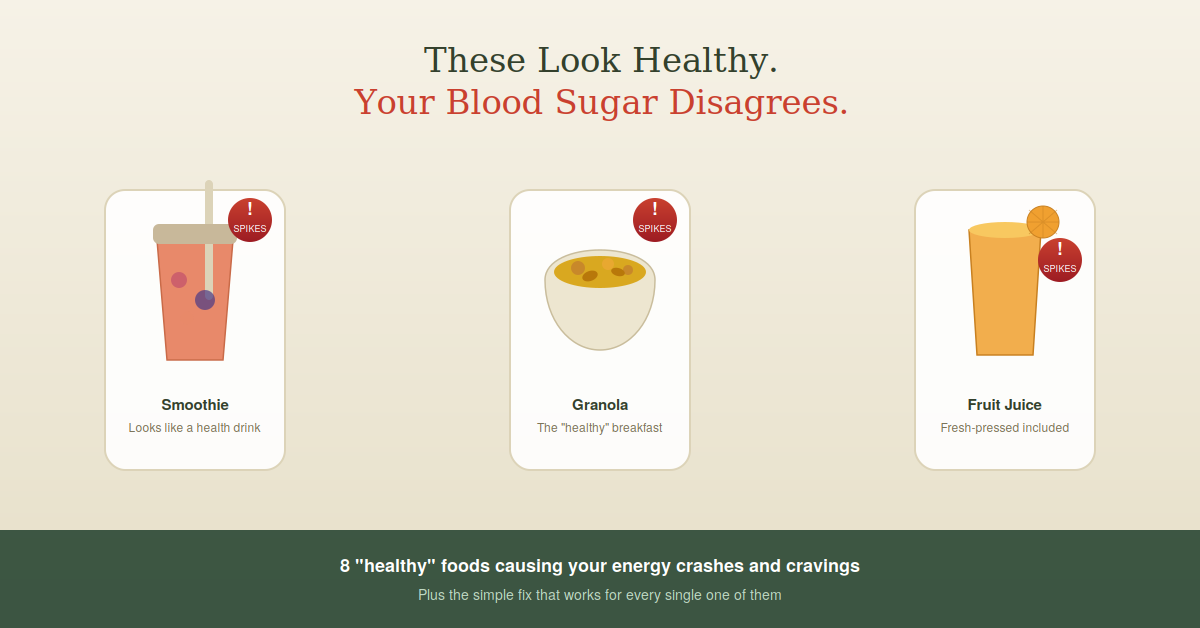
Most people know that biscuits, fizzy drinks, and sweets raise blood sugar. What they don’t realise is that many of the foods considered healthy — the ones sitting in your cupboard right now — are among the fastest at doing the same thing.
These healthy foods that spike blood sugar catch people off guard because they carry a health halo that makes them feel safe. Granola for breakfast. A smoothie mid-morning. Rice cakes as a snack. A low-fat yoghurt after lunch. By every conventional measure, that looks like a good day.
But your blood sugar doesn’t care about the label on the packet. It responds to glucose — how fast it arrives, how much of it comes at once, and whether anything is slowing it down.
The energy crashes, the afternoon brain fog, the hunger that returns an hour after eating — these are often not a willpower problem. They’re a glucose problem. And healthy foods that spike blood sugar are frequently the cause.
Here’s which ones are most commonly behind it, why they affect blood glucose levels, and what to do about each one.
Why Blood Sugar Spikes Matter Even If You’re Not Diabetic
This isn’t only relevant to people managing diabetes or prediabetes. Blood sugar spikes affect everyone, every day — and the effects are felt well before any medical diagnosis comes into the picture.
When you eat something that raises blood glucose quickly, your pancreas releases a surge of insulin to bring it back down. That insulin response often overshoots, pulling blood sugar down too fast. The result is a rapid drop in energy, increased hunger, difficulty concentrating, and cravings — usually for something sweet or starchy to bring blood sugar back up again.
This cycle, repeated several times a day through meals and snacks, is one of the most common drivers of afternoon energy crashes, persistent hunger despite eating, and gradual weight gain over time — particularly around the midsection.
Over years and decades, frequent, large blood sugar spikes contribute to insulin resistance, which is the condition where cells become less responsive to insulin’s signal. Insulin resistance sits directly upstream of type 2 diabetes, metabolic syndrome, and cardiovascular disease.
Understanding which foods drive this pattern — particularly the ones that don’t look like they should — is one of the most practical things you can do for your long-term metabolic health.
[H2 BLOCK]
1. Fruit Juice — Nature’s Fast Sugar
Whole fruit is genuinely healthy. The same fruit pressed into juice is a very different metabolic experience.
When you eat a whole orange, you’re consuming the fibre along with the sugar. That fibre slows the absorption of glucose into the bloodstream, producing a moderate, gradual rise in blood sugar. The fruit also requires chewing — which triggers digestive hormones and begins the satiety signalling process.
Juice removes the fibre entirely. What’s left is concentrated fructose that hits the bloodstream quickly with nothing to slow it down. A glass of orange juice — 250ml — contains roughly the same sugar as four whole oranges, without any of the fibre that would have moderated the glucose response from eating them.
This applies to fresh-pressed juice, not just commercial varieties. The processing method matters less than the absence of fibre.
Swap it for: Whole fruit with a handful of nuts or some yoghurt alongside — the fat and protein slow glucose absorption considerably. Or simply eat the whole fruit instead of juicing it.
[H2 BLOCK]
2. Granola and Muesli
Granola has become almost synonymous with healthy eating, which makes this one particularly surprising for a lot of people.
Most commercial granola is bound together with honey, maple syrup, or sugar, and baked until crisp — which concentrates the sugars and reduces the water content, making it easy to eat a very large portion without realising it. A typical serving is 45 grams, but most people pour considerably more than that into a bowl.
Even “natural” granola with oats, nuts, and dried fruit is a high-glycaemic breakfast for most people. Oats themselves are moderate on the glycaemic index, but the addition of sugary binders, dried fruit, and the lack of substantial protein in most granola servings means blood sugar rises quickly.
Muesli is generally better — untoasted, with no added sugar — but portions still matter, and eating it with low-fat milk rather than full-fat or protein-rich yoghurt removes a buffer that would otherwise slow glucose absorption.
Swap it for: Overnight oats with full-fat yoghurt and a handful of nuts, or eggs with whole grain toast. Both provide far more protein and fat to moderate the glucose response.
[H2 BLOCK]
3. Rice Cakes
Rice cakes have been a diet staple for decades, positioned as a light, low-calorie alternative to bread or crackers. And while they are low in calories, they’re also extremely high on the glycaemic index — higher than white bread for most people.
The reason is simple. Rice cakes are made from puffed rice, which is a highly processed, rapidly digested carbohydrate with almost no fibre, protein, or fat to slow its conversion into glucose. They hit the bloodstream quickly and produce a significant spike, followed by the familiar energy crash that sends you back to the kitchen.
The “low calorie” framing has distracted people from the glycaemic reality for years. A food can be both low in calories and highly disruptive to blood sugar — rice cakes are a good example of exactly that combination.
Swap it for: Oatcakes or whole rye crispbreads, which have more fibre and a significantly lower glycaemic response. Top either with nut butter, avocado, or smoked salmon to add protein and fat alongside.
[H2 BLOCK]
4. Low-Fat Yoghurt
Full-fat yoghurt is one of the best foods for blood sugar stability — protein, fat, and some natural lactose sugar, digested slowly and steadily. Low-fat yoghurt is something different.
When fat is removed from yoghurt, it loses much of its ability to slow digestion. To compensate for the loss of flavour, most commercial low-fat yoghurts add significant amounts of sugar, fruit concentrates, or sweeteners. A standard low-fat fruit yoghurt can contain 15 to 20 grams of sugar per pot — more than you’d find in many chocolate biscuits.
The combination of low protein, low fat, and added sugar makes low-fat flavoured yoghurt a surprisingly fast glucose raiser, despite its “healthy” positioning.
Swap it for: Full-fat plain Greek yoghurt with your own additions — a few berries, a drizzle of honey, or some chopped nuts. You get the protein and fat that slow glucose absorption, without the hidden sugar load of commercial low-fat versions.
[H2 BLOCK]
5. Smoothies
A smoothie made from whole fruit, vegetables, and some healthy extras sounds like the ideal health food. The blood sugar reality is more complicated.
The blending process breaks down the cell walls of fruit and vegetables, releasing sugars from the fibre matrix that would otherwise slow their absorption. The result is a drink that behaves more like juice than whole food in terms of how quickly glucose enters the bloodstream — particularly when the smoothie is fruit-heavy rather than vegetable-heavy.
A typical shop-bought smoothie — even one marketed as healthy and made from “100% fruit” — can contain 40 to 50 grams of sugar in a single 500ml bottle. That’s equivalent to roughly ten teaspoons, arriving in the bloodstream within 30 to 45 minutes.
Home blending is better than shop-bought, but the same principle applies. A smoothie made from three fruits, a banana, and some apple juice provides very little to slow the glucose hit.
Swap it for: A smoothie built primarily around leafy greens, cucumber, and half an avocado, with one small piece of fruit for sweetness and a scoop of protein powder or full-fat yoghurt. This dramatically changes the glucose response while keeping most of the nutritional value.
[H2 BLOCK]
6. Dried Fruit
Dried fruit sounds like a natural, wholefood snack — and in small amounts, it is. The problem is in the portion size and the concentration of sugars.
When fruit is dried, the water is removed but the sugar stays behind. A small 40-gram portion of raisins contains roughly the same sugar as a full bunch of grapes — but it’s dramatically easier to eat 40 grams of raisins without feeling full than it is to eat the equivalent volume of grapes. The absence of water means the usual signals that tell your brain “you’ve eaten a significant volume of food” don’t fire properly.
The sugar content of dates, raisins, apricots, and cranberries is extremely concentrated. A handful of trail mix containing nuts and dried fruit can push 30 to 40 grams of sugar depending on the ratio.
Swap it for: Fresh whole fruit with a small amount of nuts alongside — the combination of fibre, fat, and protein from the nuts with the natural sugars in fresh fruit produces a far more moderate glucose response than dried fruit alone.
[H2 BLOCK]
7. White Rice — Even the “Healthy” Version
White rice is widely understood to be a refined carbohydrate. What surprises more people is that even the versions sometimes positioned as healthier alternatives — sushi rice, basmati, jasmine — still produce a significant blood sugar spike for most people.
Basmati rice is the best of the group, with a lower glycaemic index than other varieties. But it’s still a rapidly digested starch in significant portions, and the glycaemic response is highly individual — some people spike dramatically on any rice, while others tolerate it relatively well.
The bigger issue is portion size and what’s eaten alongside. A large bowl of rice as the dominant component of a meal, with little protein or fat, is a reliable blood sugar spike. The same amount of rice eaten alongside a significant protein source, vegetables, and some olive oil produces a measurably different glucose response because protein, fat, and fibre all slow digestion.
Swap it for: Reducing the portion and adding more protein and vegetables to the same plate. Or switching to cauliflower rice as the base for rice-heavy dishes, which dramatically reduces the glucose load while keeping the eating experience similar.
[H2 BLOCK]
8. Sports Drinks and Coconut Water
These are positioned as natural hydration and recovery tools — and marketed heavily toward people who exercise, which creates a health halo around them.
Sports drinks were designed for endurance athletes exercising for more than 60 to 90 minutes at high intensity, who genuinely need rapid glucose replenishment. For most people, most of the time, they’re simply a fast-sugar drink in a bottle that looks like a health product.
Coconut water has a better reputation, and it does contain electrolytes naturally. But a 500ml carton also contains around 22 to 25 grams of sugar — absorbed quickly, with minimal fibre to moderate the response.
Swap it for: Water with a pinch of sea salt and a squeeze of lemon for electrolyte replenishment after normal exercise. Save sports drinks for genuine endurance training lasting well over an hour.
[H2 BLOCK]
The Simple Rule That Helps With All of These
You don’t need to eliminate any of these foods entirely. What matters more than the food itself is what surrounds it in a meal.
Protein, fat, and fibre all slow the rate at which glucose enters the bloodstream. Adding any of these alongside a carbohydrate — particularly a fast-releasing one — significantly blunts the spike.
Eating order matters too. Starting a meal with vegetables or protein before moving to the starchy or sweet component produces a lower and slower glucose rise than eating the carbohydrate first.
And portion size matters more for glucose response than most people realise. The same food in a smaller amount with more alongside it produces a completely different metabolic outcome than a large portion eaten alone.
[H2 BLOCK]
The Bottom Line
Fruit juice, granola, rice cakes, low-fat yoghurt, smoothies, dried fruit, white rice, and sports drinks are all foods that can spike blood sugar significantly despite being widely considered healthy choices.
This doesn’t mean they’re bad foods or that you need to avoid them forever. It means understanding what happens biologically when you eat them helps you make better decisions about how much, when, and what to pair them with.
The goal isn’t a perfect blood sugar line — it’s reducing the frequency and height of the spikes that drive the energy crashes, hunger, and gradual metabolic strain that most people have come to accept as normal.
This article is for informational purposes only and does not constitute medical advice. If you have diabetes, prediabetes, or any condition affecting blood sugar management, please consult a healthcare professional before making dietary changes.
[…] Read here Healthy Foods That Spike Blood Sugar — You Won’t Expect These […]