
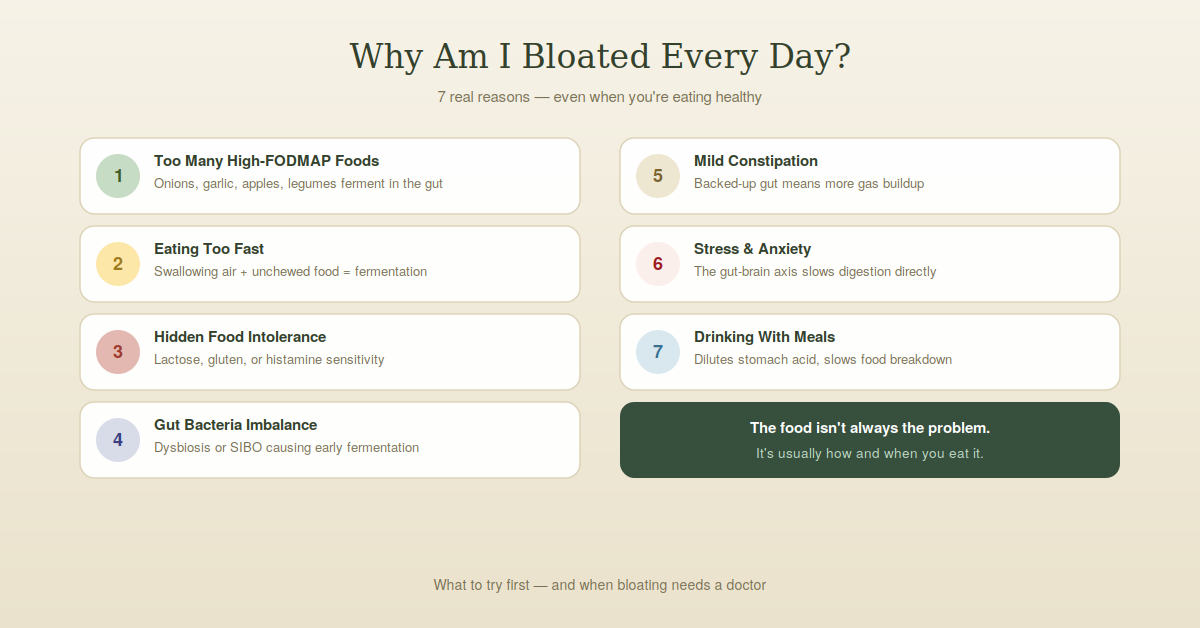
Why am I bloated every day? If you’ve been asking yourself this question despite eating a healthy diet, you’re not alone. Many people experience daily bloating even after cutting out junk food and choosing more nutritious meals. The truth is that persistent bloating often has an underlying cause, and sometimes even healthy foods can trigger it. Understanding what’s behind your symptoms is the first step toward finding lasting relief.
You’ve cut out junk food. You’re eating salads, vegetables, wholegrains, maybe some yoghurt for your gut. And yet your stomach still swells up by midday, you feel uncomfortable after almost every meal, and nothing seems to consistently make it better.
This is one of the most common and most confusing digestive complaints there is — and the frustrating part is that “healthy” food is sometimes exactly what’s causing it.
Daily bloating rarely has a single cause. But it almost always has a real, identifiable one. Here are the most common reasons your stomach is swelling every day, even when you’re doing everything right nutritionally.
1. You’re Eating Too Many High-FODMAP Foods at Once
This is the one that surprises most people, because many of the foods involved are genuinely healthy.
FODMAPs are a group of fermentable carbohydrates found in a wide range of everyday foods — onions, garlic, apples, beans, lentils, wheat, cauliflower, mushrooms, and many others. For most people, these foods are digested without issue. But for a significant number of people, these carbohydrates aren’t fully absorbed in the small intestine. Instead, they travel to the large intestine where gut bacteria ferment them, producing gas.
The result is bloating, distension, and discomfort — often a few hours after eating rather than immediately.
The reason this trips people up is that a “healthy” meal can be loaded with FODMAPs without looking remotely problematic. A bowl of lentil soup with onion and garlic, followed by an apple, followed by a handful of cashews, is a remarkably high-FODMAP day. Your gut bacteria are doing exactly what they’re supposed to do — the problem is the volume of fermentable material arriving all at once.
A low-FODMAP elimination diet, done properly for two to six weeks and then carefully reintroduced, is one of the most effective ways to identify which specific foods are driving your bloating.
What to try: Rather than overhauling your whole diet immediately, start paying attention to which specific foods consistently appear before a bloating episode. Common culprits include onion and garlic — which are in almost everything — wheat, dairy, apples, and legumes.
2. You’re Eating Too Fast
This one is embarrassingly simple and genuinely worth taking seriously.
When you eat quickly, you swallow significantly more air than you do when you eat slowly. That air ends up in your digestive tract and contributes directly to bloating and gas. Fast eating also means food arrives in your stomach in larger, less-chewed chunks, which your digestive enzymes have to work harder to break down — and partially digested food fermenting in the gut produces more gas.
There’s also the satiety signal timing issue. Your brain takes roughly 20 minutes to register fullness from the hormones your stomach releases. Eat quickly and you’ll consume significantly more than you need before that signal arrives — which means a stretched, uncomfortable stomach before your body even registers that it’s full.
Most people dramatically underestimate how fast they eat. If you can finish a meal in under 10 minutes, that’s fast. For reference, digestion works better when you’re chewing each mouthful 20 to 30 times before swallowing.
What to try: Put your fork or spoon down between bites. Eat without screens — scrolling while eating is one of the most reliable ways to eat faster than you mean to without noticing.
3. You Have a Hidden Food Intolerance
Lactose intolerance and gluten sensitivity get most of the attention, but food intolerances are broader and more varied than most people realise.
Lactose — the sugar in dairy products — requires an enzyme called lactase to be properly digested. Lactase production declines naturally with age in most people. If you’re not producing enough, lactose travels undigested to the large intestine, where bacteria ferment it. Bloating, gas, and discomfort typically arrive 30 minutes to two hours after eating dairy.
Non-coeliac gluten sensitivity is different from coeliac disease — it doesn’t produce the same immune response or intestinal damage — but it can still cause significant bloating, brain fog, and digestive discomfort in people who are sensitive to gluten or to other compounds in wheat, such as fructans.
Histamine intolerance is less commonly discussed but worth knowing about. Some people have reduced activity of the enzyme that breaks down histamine, which means foods high in it — aged cheeses, fermented foods, wine, cured meats, smoked fish — cause bloating and other symptoms. If you’ve tried low-FODMAP without full resolution and eat a lot of fermented foods for gut health, histamine is worth investigating.
What to try: An elimination diet is the most reliable way to identify food intolerances — removing the suspected food entirely for two to four weeks, then reintroducing it deliberately to observe the response. Avoid testing multiple foods simultaneously, as it makes it impossible to identify the specific trigger.
4. Your Gut Bacteria Are Out of Balance
Your gut contains trillions of bacteria, and the balance between different species directly affects how much gas is produced during digestion.
When harmful or gas-producing bacteria are present in higher numbers than they should be — a state called dysbiosis — fermentation in the gut becomes more intense, producing more gas from the same meals that previously caused no issues. This is why bloating can suddenly develop or worsen even when your diet hasn’t changed.
A more specific version of this is SIBO — Small Intestinal Bacterial Overgrowth. Normally, bacteria are concentrated in the large intestine. In SIBO, bacteria migrate into the small intestine and begin fermenting food there, much earlier in the digestive process than they should. This produces significant bloating that tends to worsen as the day goes on, along with gas, irregular bowel habits, and sometimes nutrient deficiencies.
SIBO is more common than people think and is frequently misdiagnosed as IBS. It’s worth considering if your bloating is persistent, doesn’t respond to dietary changes, and is accompanied by fatigue or nutrient deficiencies.
What to try: Supporting gut bacteria diversity through a varied, fibre-rich diet, reducing ultra-processed foods, and limiting unnecessary antibiotic use all help maintain a healthier balance. If SIBO is suspected, a breath test — available through a gastroenterologist or some GP clinics — can confirm or rule it out.
5. You’re Constipated — Even If You Don’t Realise It
Constipation doesn’t always feel obvious. You don’t necessarily need to be going days without a bowel movement to have a backlog that’s contributing to bloating.
When stool sits in the colon for longer than it should, bacteria have more time to ferment the contents — producing gas that has nowhere to go. The result is a bloated, heavy, uncomfortable feeling that builds through the day and is often worse by evening.
Many people are mildly constipated by clinical definition — fewer than three complete bowel movements per week, or movements that feel incomplete — without thinking of themselves as constipated. Dehydration is one of the most common contributors, since the colon draws water from stool if the body is short on fluids, making it harder and more difficult to pass.
Low fibre intake, a sedentary lifestyle, and chronic stress all slow gut motility and contribute to the same issue.
What to try: Drink water consistently throughout the day rather than in large amounts at once. Increase soluble fibre gradually — too much too fast actually worsens bloating while your gut adjusts. Walking after meals significantly improves gut motility and helps move things along naturally.
6. Stress and Anxiety Are Directly Affecting Your Gut
The gut-brain connection is real and direct, and chronic stress is one of the most underappreciated causes of daily bloating.
Your gut has its own nervous system — the enteric nervous system — that communicates constantly with the brain. When stress activates the fight-or-flight response, it directly affects gut motility, digestive enzyme secretion, and the sensitivity of the gut lining. This can slow digestion, alter the balance of gut bacteria, and make the gut lining more reactive to normal digestive processes.
People with anxiety often notice that their gut symptoms are significantly worse during stressful periods, even when diet hasn’t changed at all. The gut genuinely responds to emotional state — not as a vague mind-body concept, but as a measurable physiological reality.
Stress also affects eating behaviours — rushing meals, eating less mindfully, making different food choices — all of which compound the problem.
What to try: Deep breathing before and during meals activates the parasympathetic nervous system — the “rest and digest” state — which directly supports better digestion. Even five slow breaths before eating makes a difference. Managing chronic stress through sleep, exercise, and reducing ongoing pressures has a direct, measurable effect on gut symptoms over time.
7. You’re Drinking Too Much With Your Meals
This is a small habit that has a surprisingly large effect on bloating.
Drinking large amounts of liquid during a meal dilutes your stomach acid and digestive enzymes, reducing their ability to properly break down food. Partially digested food reaching the intestines ferments more readily, producing more gas.
Carbonated drinks are worse — the bubbles introduce gas directly into your digestive system, and the carbon dioxide expands in the warmth of your stomach.
Drinking through a straw also introduces more air than drinking directly from a glass, which goes directly into your digestive tract.
What to try: Drink most of your fluids between meals rather than with them. If you want something to drink with food, sip rather than gulp, and avoid carbonated drinks with meals. Warm herbal teas — particularly peppermint and ginger — actually support digestion and can help reduce bloating rather than contributing to it.
What Actually Helps Bloating Day to Day
There’s no single fix for daily bloating because the cause determines the solution. But a few changes tend to help regardless of the specific trigger.
Eating more slowly and mindfully makes a real difference across almost every cause. So does drinking water consistently between meals, walking after eating, and reducing the volume of high-FODMAP foods in any single meal even if you can tolerate them individually.
A food and symptom diary for two weeks — noting what you eat, when symptoms appear, and how severe they are — is one of the most useful things you can do to start identifying your personal pattern. Most people find that two or three specific triggers account for the majority of their symptoms once they start tracking properly.
If bloating is severe, persistent, accompanied by weight loss, blood in stool, significant pain, or vomiting, it warrants a medical assessment rather than a dietary trial at home.
The Bottom Line
Daily bloating when eating healthily almost always has a real, identifiable cause. The most common ones are high-FODMAP food combinations, eating too fast, food intolerances, gut bacteria imbalance, mild constipation, stress, and drinking habits around mealtimes.
Most of these are fixable without medication and without dramatic dietary overhauls — they just require identifying which specific thing is driving the problem for you rather than applying generic advice that may not match your situation.
Start with the simplest changes first — eating speed, water intake, and meal composition — and work from there.
This article is for informational purposes only and does not constitute medical advice. If you experience severe or persistent bloating alongside other symptoms such as unexplained weight loss, blood in stool, or severe abdominal pain, please consult a healthcare professional promptly.