
What happens when you quit sugar depends largely on how much added sugar you were eating in the first place and what you replace it with. Cutting back on sugary drinks, sweets, desserts, and heavily processed foods may lead to noticeable changes in energy, appetite, and cravings, although the experience isn’t identical for everyone. Some people feel better within days, while others initially struggle with stronger cravings or changes in mood and energy. The important distinction is that quitting sugar doesn’t mean eliminating all carbohydrates or naturally occurring sugars from foods like fruit and milk. Instead, the focus should be on reducing added sugars while building a balanced diet around whole, minimally processed foods.
Quitting sugar is one of those things that sounds straightforward until you actually try it. Then you discover your energy crashes for a week, you’re inexplicably irritable, and suddenly everything you walk past seems to contain sugar.
But if you stick with it, the changes your body goes through are genuinely significant — and some of them happen faster than most people expect.
Here’s exactly what happens, in roughly the order it tends to happen, when you cut added sugar out of your diet. Not the vague wellness version. The real, biological one.
One honest note before we start: there’s a difference between reducing added sugar — the kind in fizzy drinks, biscuits, sauces, and processed food — and eliminating all sugar entirely, including from fruit and wholegrains. New research from ENDO 2026 found that complete elimination can actually disrupt gut bacteria and worsen metabolic markers. The changes below apply to cutting out added sugar specifically, which is what the evidence actually supports.
1. The First Week Is Harder Than You Expect
This isn’t a scare tactic. It’s just true, and knowing it in advance makes it easier to push through.
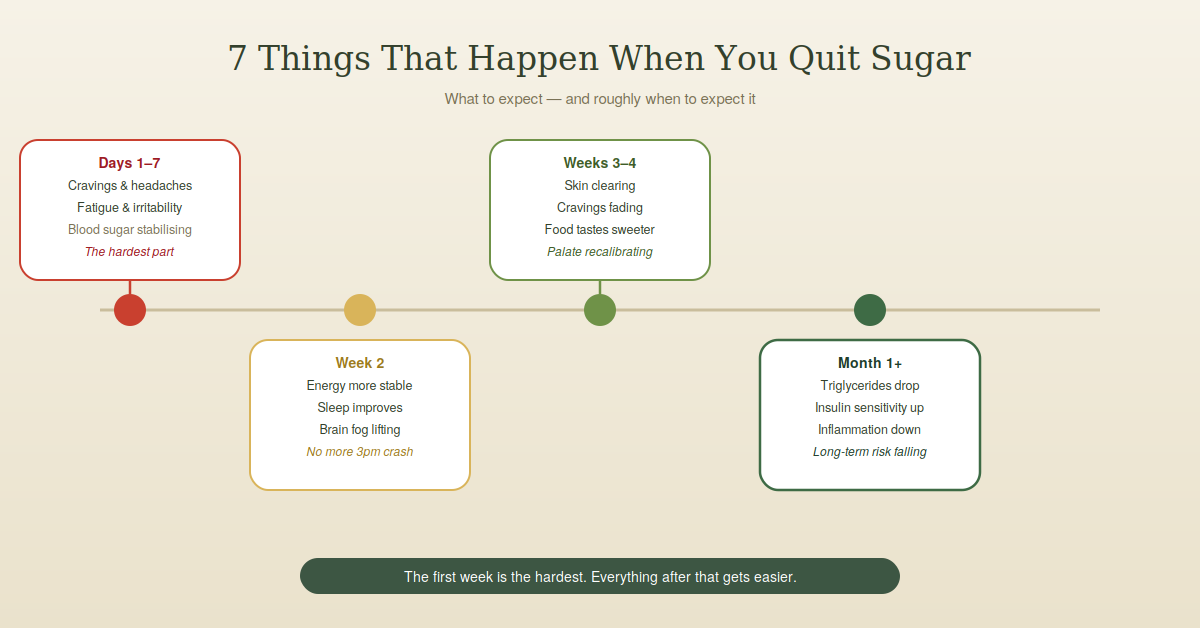
In the first three to five days after cutting added sugar, many people experience headaches, fatigue, irritability, and intensified cravings. This happens because your brain has adapted to regular sugar hits — each one triggered a small dopamine release, and now that signal is gone.
Your blood sugar also has to stabilise. If your previous diet included a lot of refined carbohydrates and sugar, your glucose levels were riding a daily rollercoaster of spikes and crashes. That rollercoaster is now stopping, and your body needs a few days to find a steadier baseline.
The good news: for most people, the worst of it passes within five to seven days. After that, most of the changes listed below start moving in the right direction.
2. Your Energy Becomes More Stable
This is usually the first positive change people notice, and it often surprises them with how different it feels.
Sugar-driven energy is borrowed energy. When you eat something high in added sugar, your blood glucose spikes rapidly, triggering an insulin response that brings it back down — often too quickly, leaving you in an energy trough that makes you reach for something sweet again. That cycle repeats throughout the day.
When you remove added sugar, blood glucose levels stabilise. There are no more sharp spikes, which means no more sharp drops. Energy becomes flatter and more sustained rather than riding peaks and valleys.
Most people describe it as feeling “more even” — not necessarily more energetic in a buzzy way, but without the 3pm crash that used to be their reliable daily companion.
An NIH study found that people who removed added sugar from their diet for just two weeks consumed roughly 25% fewer daily calories overall — largely because stable blood sugar dramatically reduces the urge to snack between meals.
3. Your Skin Starts to Change
Sugar and skin have a closer relationship than most people realise, and it works through a specific mechanism called glycation.
When excess sugar circulates in your bloodstream, it binds to collagen and elastin fibres — the proteins that keep skin firm and elastic — in a process that makes them stiff and less functional. Over time, this accelerates the visible signs of aging and contributes to a dull, uneven complexion.
High sugar intake also drives insulin-like growth factor (IGF-1) production, which increases sebum production and promotes the kind of inflammation associated with acne, particularly the hormonal kind.
When you cut added sugar, both of these mechanisms ease off. Glycation slows. IGF-1 levels stabilise. Inflammation decreases.
Most people who cut sugar report noticeable skin improvements — clearer texture, fewer breakouts, and a more even tone — within two to four weeks. It won’t fix every skin issue, but for many people it’s one of the more visible and motivating early changes.
4. You Start Sleeping Better
This one catches most people off guard.
The connection between sugar and sleep comes back to blood glucose stability. When blood sugar drops in the early hours of the morning — something that happens more dramatically when the previous day included a lot of sugar — the body releases cortisol and adrenaline to pull it back up.
Those hormones are designed to wake you up. Which is exactly what they do, typically between 2am and 4am, often leaving you lying there unable to get back to a deep sleep.
When blood sugar stabilises through reduced added-sugar intake, those overnight glucose drops become less severe. The cortisol surge doesn’t need to happen. Sleep is less likely to be interrupted in that critical early-morning window.
Beyond the blood sugar mechanism, reduced sugar intake is associated with more time spent in slow-wave deep sleep — the most physically restorative sleep stage — and less light, fragmented sleep overall.
5. Your Brain Works More Clearly
There’s reasonable evidence that chronically high sugar intake interferes with cognitive function, and that reducing it improves clarity and focus.
High glucose levels are associated with reduced production of BDNF — brain-derived neurotrophic factor — a protein that supports the growth of new brain cells and strengthens connections between existing ones. Lower BDNF is associated with poorer memory, slower cognitive processing, and higher risk of depression.
National Geographic, citing research on this mechanism, noted that limiting sugar before cognitively demanding tasks may help with focus and clarity, with evidence that sugar can block memory receptors in the brain.
Most people who cut added sugar report that the brain fog they’d normalised as “just how I feel” begins to lift within two to three weeks. This is particularly noticeable in the afternoons, when the post-lunch energy dip — driven largely by the blood sugar spike from a carbohydrate-heavy lunch — stops being a daily occurrence.
6. Your Relationship With Food Starts to Change
This is one of the more unexpected and longer-term changes — and arguably one of the most valuable.
Added sugar is specifically engineered to override satiety signals. It’s calorie-dense without being satiating, which is why it’s so easy to consume far more of it than you intend to. It also creates a reward loop in the brain that makes foods high in sugar feel more compelling than they would otherwise.
When you remove it consistently, two things happen. First, your palate recalibrates. Foods that seemed not particularly sweet before — fruit, certain vegetables, plain dairy — start tasting noticeably sweeter. This happens because the baseline your taste receptors are calibrated against has shifted.
Second, the cravings themselves diminish. Not immediately — the first week is exactly as rough as described above — but usually within two to three weeks, the intensity of sugar cravings drops substantially for most people. The pull toward sweet things is still there, but it’s not the relentless, intrusive urge it was before.
7. Your Risk Markers Start Moving in the Right Direction
This is the longer-term payoff, and it’s worth knowing about even if you can’t feel it directly.
Chronically high added-sugar intake is linked to elevated triglycerides, reduced HDL cholesterol, increased insulin resistance, and systemic low-grade inflammation — all of which sit upstream of cardiovascular disease, type 2 diabetes, and metabolic syndrome.
When you cut added sugar, these markers begin to improve. Triglycerides drop, often within weeks. Insulin sensitivity improves. Inflammatory markers like CRP decline.
None of these changes are visible or immediately felt in the way energy or skin changes are. But they represent a genuine, measurable reduction in long-term disease risk that plays out over months and years — and they start moving in the right direction faster than most people assume.
One Thing to Watch Out For
Not all “no added sugar” approaches are equal, and this is where a common mistake gets made.
Many people who try to quit sugar end up replacing it with large amounts of artificial sweeteners — in diet drinks, “sugar-free” products, and protein bars. The research on artificial sweeteners is mixed at best.
Some evidence suggests they maintain the brain’s expectation of sweetness without delivering it, which can actually preserve cravings rather than reducing them. Some also appear to disrupt the gut microbiome over time. They’re not a neutral swap.
The other thing worth knowing, given the ENDO 2026 research mentioned at the start: the goal is reducing added sugar, not eliminating all carbohydrates or all natural sugars. Fruit, wholegrains, and legumes contain sugar too, but they also contain fibre, micronutrients, and compounds that support gut bacteria. Cutting those alongside added sugar is a different — and potentially counterproductive — approach.
The Bottom Line
Cutting added sugar from your diet produces real, measurable changes across energy, sleep, skin, cognition, and long-term metabolic health. Most of the positive changes start within one to three weeks of consistently reducing intake.
The first week is genuinely uncomfortable. The cravings are real. The fatigue and irritability are real. But they’re temporary — and what’s on the other side of them is a body running on steadier fuel, sleeping more deeply, and gradually lowering its risk for some of the most common long-term conditions.
You don’t need to be perfect. You don’t need to eliminate every gram. But added sugar — the kind in fizzy drinks, packaged snacks, sauces, and processed food — is the place where the evidence is clearest, and where the return on reducing it is highest.
This article is for informational purposes only and does not constitute medical advice. If you have diabetes, insulin resistance, or any condition affecting blood sugar, speak with a healthcare professional before making significant dietary changes.