
If you’ve been wondering exactly how much protein per meal for weight loss after 40 actually makes a difference, the answer isn’t found in your daily total — it’s in how that total gets split across the day. You might already be hitting your daily protein target and still feel like your body is losing muscle faster than it should, or notice your weight loss has stalled despite “eating enough protein.” The real issue is usually distribution, not quantity.
This is one of those nutrition details that gets lost in most general advice, because most protein guidance is written as a single daily number — “eat 100 grams of protein a day” — without addressing how that number gets distributed. For adults over 40 specifically, the distribution turns out to matter more than it does for someone in their twenties, and the research explaining why is more specific than most weight loss content covers.
Why a Daily Protein Total Isn’t the Whole Picture
Most protein recommendations are built around a 24-hour total, which made sense as a simplifying assumption for general nutrition advice. The problem is that your body doesn’t actually use protein in one continuous, even stream throughout the day. It uses it in response to specific meals, and there’s a biological ceiling on how much of a single dose your body can actually put to use for muscle maintenance at one sitting.
Research on dietary protein distribution found that spreading protein relatively evenly across meals produced meaningfully better 24-hour muscle protein synthesis than the same total amount eaten in a skewed pattern — for example, very little at breakfast, a moderate lunch, and a large dinner, which is the pattern many people fall into without really planning it that way.
This matters specifically for weight loss because muscle tissue is metabolically expensive to maintain — it burns more calories at rest than fat tissue does. If your eating pattern is quietly allowing muscle loss alongside fat loss during a calorie deficit, your metabolism slows more than it needs to, which is part of why weight loss can stall even while the scale technically moves in the right direction for a while.
The Specific Number That Changes After 40
This is where the research gets genuinely more precise than typical advice, and it centers on a concept called anabolic resistance.
As the body ages, the same amount of protein at a single meal triggers a smaller muscle-building response than it would have at a younger age. Researchers describe this as a diminished response to protein intake that accompanies aging — essentially, the muscle-building machinery becomes less sensitive to the same input, requiring a larger per-meal dose to achieve the same effect.
For adults under 30, research generally points to around 20 to 25 grams of protein per meal as sufficient to maximize the muscle-building response. For adults over 30, and especially moving into the 40s, 50s, and beyond, the research indicates the effective threshold rises to approximately 0.4 grams per kilogram of body weight per meal, which translates to roughly 30 to 40 grams per meal depending on body size. Below this threshold, a meal may technically contain “enough protein” by general standards while still under-triggering the response your body specifically needs at this stage of life.
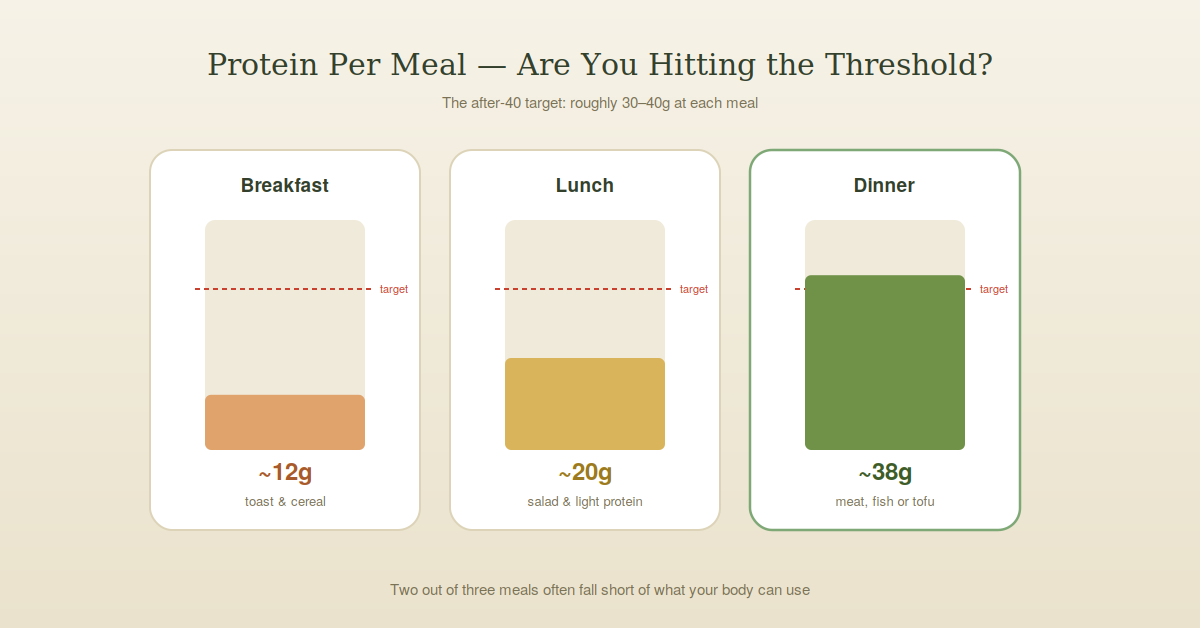
To put this in concrete terms: a 90-gram daily protein total split as oatmeal for breakfast, a light salad for lunch, and a larger dinner might satisfy a basic daily number on paper, while still falling short at both breakfast and lunch individually — meaning two out of three meals aren’t reaching the threshold where your body, after 40, can fully use the protein for muscle maintenance.
Read more 10 Weight Loss Myths That Need to Die
Why This Connects Directly to Weight Loss, Not Just Muscle
It’s worth being clear about why a muscle-focused detail matters if your actual goal is losing weight rather than building muscle specifically.
For anyone actively losing weight, particularly through a calorie deficit, there’s an unavoidable risk of losing some lean muscle mass alongside fat, simply because the body is in an overall energy-restricted state. Inadequate protein, or protein eaten in a pattern that doesn’t reach the effective per-meal threshold, accelerates this muscle loss specifically during weight loss. Less muscle mass translates directly to a lower resting metabolic rate, which works against the entire point of the effort.
This concern has become more directly relevant in dietary research recently because of the rise of GLP-1 medications for weight loss. Inadequate protein intake at each meal, particularly during reduced appetite and lower overall calorie intake associated with these medications, can accelerate muscle loss and metabolic decline beyond what would be expected from calorie reduction alone. Even for people not using medication, the underlying principle is the same: a calorie deficit makes hitting the per-meal protein threshold more important, not less, because there’s less overall food volume to work with.
What This Looks Like in an Actual Day
Translating the research into a practical pattern is simpler than it might sound, even though it does require a small shift in how breakfast and lunch are usually approached.
Breakfast is typically the meal furthest from the 30-to-40-gram threshold for most people, since traditional breakfast foods, including most cereals, toast, and plain oatmeal, are carbohydrate-heavy and comparatively low in protein. Reaching the threshold at breakfast generally means deliberately adding a concentrated protein source — eggs, Greek yogurt, a protein-added smoothie, or cottage cheese — rather than relying on what a typical breakfast naturally provides.
Lunch is the second most common gap, especially for anyone eating a salad-based or lighter midday meal. A salad with a modest portion of grilled chicken or a few hard-boiled eggs scattered on top often falls short of the threshold unless the protein portion is specifically built up to around four to six ounces of a lean protein source.
Dinner tends to naturally land closer to or above the threshold for most people already, since dinner is typically the meal where a more substantial protein portion, like meat, fish, or tofu, is the default centerpiece.
The practical shift, then, isn’t usually about eating more protein overall in dramatic terms — it’s about deliberately moving some of what would otherwise be a dinner-heavy protein load earlier into the day, so that breakfast and lunch each independently clear the threshold rather than relying on dinner to make up for two under-protein meals.
Read more What Is GLP-1 and Why Do Doctors Say It Is the Key to Weight Loss
A Related Timing Detail Worth Knowing
There’s a second, related piece of research worth mentioning here, separate from per-meal amount but connected to the same broader idea that when you eat matters alongside what you eat.
Research on meal timing has found that consuming a larger share of daily calories earlier in the day, rather than concentrated in the evening, is associated with better weight loss outcomes and reduced obesity risk, compared to the same total calories weighted toward a large evening meal. One review of meal timing studies found that consuming a larger evening meal specifically is linked to a notably higher obesity risk pattern compared to a similar calorie load eaten earlier.
It’s worth being appropriately cautious here, though: the overall quality of evidence in this specific area has been described by researchers as low to moderate, due to considerable variation between study designs and the difficulty of isolating meal timing from other factors like overall calorie intake and exercise. The directional finding is reasonably consistent across studies, but it shouldn’t be treated as a precisely quantified, settled effect the way some specific protein-per-meal numbers are.
Combined, the practical takeaway from both lines of research points the same direction: front-loading more of your protein, and to a lesser, less certain extent, more of your overall calories, earlier in the day appears to support weight loss and muscle maintenance better than a pattern that saves most of both for dinner.
A Few Practical Notes
This isn’t about hitting an exact gram count with precision at every single meal — the research describes a general threshold range, not a number that needs to be hit on a kitchen scale every day. Getting reasonably close, most days, is what the underlying studies were actually measuring.
It’s also not a reason to add excessive protein beyond what’s useful. The threshold research describes a point of diminishing returns, not a “more is always better” relationship — once a meal clears roughly the 30-to-40-gram range, additional protein at that same sitting doesn’t appear to meaningfully add to the muscle-protein-synthesis response, even though it may still count toward general nutrition.
For anyone with kidney concerns or another condition where protein intake needs medical oversight, this kind of adjustment is worth discussing with a doctor or dietitian first, since the general research above is aimed at otherwise healthy adults rather than people managing a specific medical condition affecting protein metabolism.
The Bottom Line
If you’re over 40 and trying to lose weight while preserving muscle, the daily protein total you’ve been tracking might be technically adequate while still being poorly distributed in a way that undermines the goal. The research on anabolic resistance points to a fairly specific per-meal target, roughly 30 to 40 grams depending on body size, as the threshold where your body can actually put that protein to use for muscle maintenance at this stage of life — and breakfast and lunch are the two meals most likely to be quietly falling short of it.
The fix isn’t necessarily eating more protein in total. For a lot of people, it’s simply moving protein that would otherwise be saved for dinner earlier into the day, so each meal independently does its job instead of relying on one large evening meal to cover for two lighter ones.
Frequently Asked Questions
Can I eat too much protein at one meal?
Eating more than the 30-to-40-gram threshold at a single meal isn’t harmful for most healthy adults, but research suggests there’s a point of diminishing returns — once a meal clears roughly that range, extra protein at the same sitting doesn’t meaningfully add to the muscle-protein-synthesis response. It’s not wasted nutritionally, but it won’t give you extra benefit toward this specific goal either.
Does this protein-per-meal threshold apply to women the same way it does to men?
The research on anabolic resistance and per-meal thresholds applies to both sexes, though the exact gram target will naturally be lower for someone with a smaller body weight, since the recommendation scales to roughly 0.4 grams per kilogram of body weight rather than being a fixed number for everyone.
What counts as a “meal” for this purpose — does a protein shake or snack count?
Most of the research behind this threshold was conducted using standard meals rather than small snacks, so a substantial snack containing 30+ grams of protein, like a large protein shake, can count, but a small snack with only 5 to 10 grams of protein generally won’t trigger the same response as a full meal hitting the threshold.
Is it better to eat more, smaller meals or fewer, larger ones to hit this threshold?
The research focused on distributing protein evenly across however many meals a person already eats, rather than recommending a specific number of meals per day. Three meals that each individually clear the threshold appear to work as well as more frequent eating, as long as the per-meal amount is adequate.
Do I need to eat animal protein to hit 30 to 40 grams per meal, or can plant-based sources work?
Plant-based sources can absolutely reach this threshold, though it sometimes takes a larger portion size or combining sources, since many individual plant proteins are less calorie-and-protein-dense per serving than meat, fish, or eggs. Tofu, tempeh, legumes combined with grains, and protein-fortified plant products can all be built up to the threshold with some attention to portion size.
This article is for informational purposes only and does not constitute medical advice. Please consult a healthcare provider or registered dietitian before making significant changes to your diet, particularly if you have a kidney condition or another condition affecting protein metabolism.